
Calculating Future Medical Expenses in a Texas Lawsuit

In Texas, calculating future medical expenses for a lawsuit means developing an evidence-based estimate of the care an injury is likely to require, not applying a formula to a diagnosis. Medical records document treatment to date; medical opinions and, when appropriate, a life care plan can identify anticipated treatment, equipment, and support. A projection can also account for how long care may continue and how medical costs may change over time.
It’s understandable to want a clear figure when future treatment could affect your finances for years. A credible estimate, however, is not a guess: it links each projected expense to the injury and supporting evidence. This article explains how records, expert opinions, life care plans, and anticipated needs work together, including how temporary treatment differs from long-term support. You’ll see what makes a projection detailed, understandable, and useful when evaluating a claim.
Table of Contents
Proving Future Medical Costs in Personal Injury Lawsuits
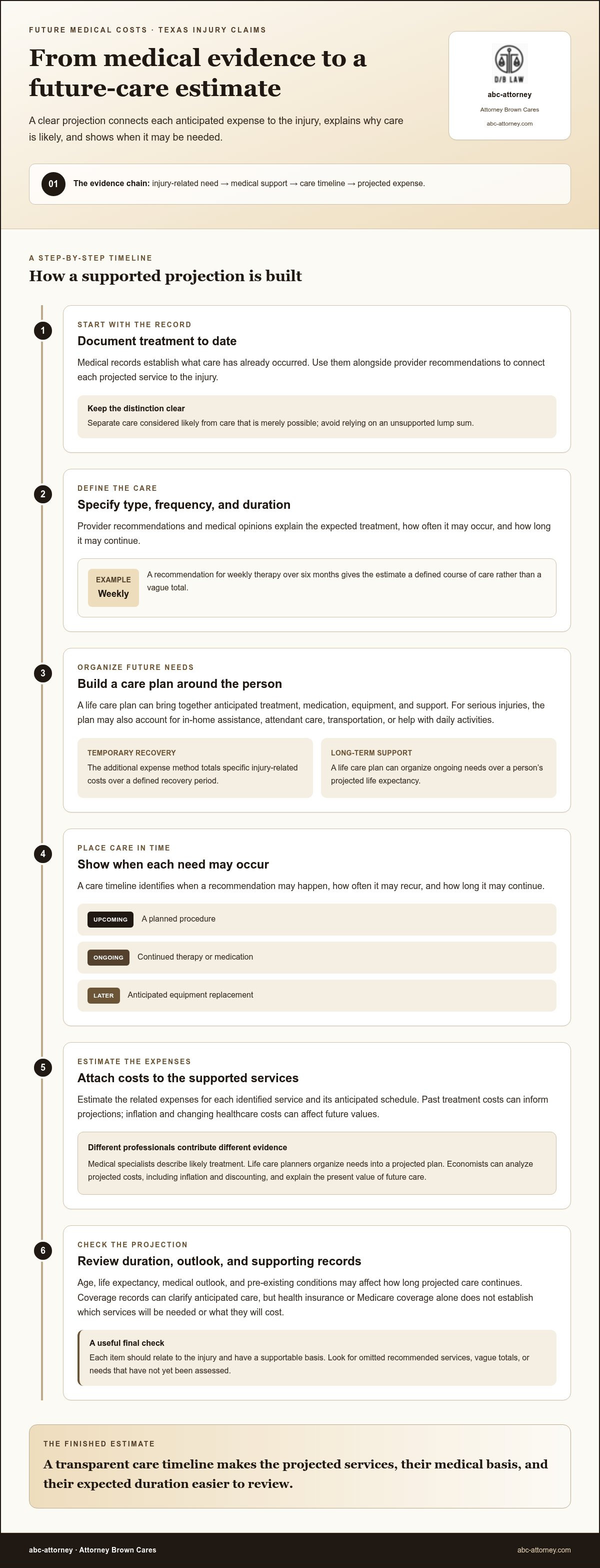
In a Texas personal injury claim, anticipated medical expenses need evidence connecting the care to the injury. Calculating future medical expenses for a lawsuit involves identifying expected services, explaining their medical basis, and estimating when they may be needed. The projection should distinguish likely treatment from care that is merely possible, helping you evaluate a settlement against documented needs.
Projecting Treatment Duration and Costs
A future-care projection identifies the type, frequency, and expected duration of treatment, then estimates the related expenses. Medical records and provider recommendations can explain why care may continue after initial treatment. For example, a recommendation for continued physical therapy should state its purpose and anticipated schedule. This detail gives the claim a concrete basis instead of an unsupported lump sum.
Estimating Costs for Time-Limited Injuries
The additional expense method totals injury-related costs expected over a defined recovery period. It can include follow-up visits, medication, therapy, or a planned procedure without projecting those costs across a lifetime. A useful estimate identifies each service, its frequency, and the relevant period. For example, a recommendation for weekly therapy over six months can be translated into a projected course of sessions.
Factors Affecting Future Cost Projections
Projected costs depend on the injury, medical outlook, treatment schedule, and expected duration of care. Age and pre-existing conditions may also affect the estimate, particularly when a serious injury creates lasting needs. Past treatment costs can inform projections, while inflation and changing healthcare costs affect future values. When calculating future medical expenses for a lawsuit, each item should relate clearly to the injury and have a supportable basis.
Catastrophic injuries may require more than appointments and procedures. Someone who needs help with daily activities may require attendant care, in-home support, assistive devices, or transportation to treatment. Medical records and expert opinions can explain how each need stems from the injury. A detailed projection can distinguish immediate services from needs expected to continue or change over time.
Future care covered by health insurance or Medicare may still be included in a claim when evidence supports the expenses and their connection to the injury. Coverage alone does not establish which services will be needed or what they will cost. Treatment and coverage records can help clarify which care remains anticipated.
Projected expenses should be connected to the injury and supported by evidence. Common mistakes include leaving out a recommended service, relying on a vague total, or settling before future needs are assessed. Once a settlement is finalized, additional compensation may no longer be available. A careful approach to calculating future medical expenses for a lawsuit helps clarify anticipated care before settlement decisions are made.
Life care plans and the total lifestyle approach
A life care plan organizes anticipated treatment, medication, equipment, and support into a projected care plan. It helps show how accident-related needs may continue and what resources they require.
Life Care Plans and Future Needs
A life care plan uses medical records and provider recommendations to outline future services and related costs. A planner can account for procedures, therapy, medications, equipment, and in-home assistance over a person’s projected life expectancy. The total lifestyle approach adds ongoing expenses and future procedures when an injury prevents independent living. This broader view matters because care may involve daily support, not just clinic visits.
Professionals in Future-Care Claims
Medical specialists describe likely treatment, while life care planners organize those needs into a projected plan. A doctor, for example, may explain why a procedure is expected, and a therapist may outline continued rehabilitation. Legal professionals use the supporting records and testimony to present the claim. Economists can analyze projected costs, including inflation and discounting, and explain the present value of future care.
Turning Recommendations Into a Care Timeline
A care timeline shows when each recommendation may occur, how often it may recur, and how long it may continue. Start with the medical recommendation, then establish its anticipated frequency and duration. A timeline might separate an upcoming procedure from ongoing therapy and later equipment replacement. This structure makes the estimate easier to review because each expense fits into the person’s anticipated course of care.
Estimating Treatment, Medication, and Equipment
Life care planners review records and recommendations to identify the type, frequency, and expected duration of treatment, medication, and equipment needs. For medication, the estimate can account for continued use recommended by the treating provider. For equipment, it can identify the item and anticipated replacement needs. Specialist opinions explain how each need relates to the injury, while cost projections and life expectancy help shape the overall estimate.
For serious injuries, a plan can connect clinical recommendations with practical needs, such as home modifications or help with daily activities. Those details show how future medical care may affect ordinary routines, not just treatment schedules. A legal review can help assess whether the records, care timeline, and financial analysis support a complete future-care claim. Discuss future-care evidence when you need help evaluating how these pieces fit together.
Review of medical records and expert opinions
Medical records establish the treatment received so far, while expert opinions explain what care may follow. Together, they tie an injury claim’s future-care estimate to documented findings and a medical prognosis.
Reviewing Medical Records and Prognosis
Reviewing medical records means tracing the injury from diagnosis through treatment, test results, and follow-up visits. This timeline helps a doctor assess whether recovery has plateaued and what care may remain. For example, records showing persistent symptoms after treatment can inform a prognosis that includes further therapy or specialist follow-up. A careful review can also identify gaps or changes that may affect the estimate.
Medical Evidence and Expert Testimony
Medical evidence and expert testimony explain why future care is needed and how it relates to the injury. A treating doctor can describe the patient’s condition, while a relevant specialist can address likely procedures, therapy, or equipment. In a brain injury case, for example, the prognosis may include continued therapy and specialist care. Testimony should connect each projected service to medical findings, not merely list possible treatments.
Economic Expert Testimony
An economic expert turns supported future-care needs into a financial projection. The analysis can account for treatment timing and duration, medical-cost inflation, and discounting to present value. Recurring therapy and a future procedure, for example, follow different schedules, so the expert assesses them separately. This gives a jury or settlement discussion a clearer explanation of how projected expenses were calculated and which assumptions shaped the total.
When Expert Testimony Is Required
Medical expert testimony is typically required to establish the need for future medical care in a personal injury lawsuit. A prognosis helps show which treatment is expected and why, while evidence of anticipated costs supports the amount claimed. A consultation with an experienced medical professional can clarify the difference between a medically supported recommendation and a possibility without a treatment basis.
For a well-supported claim, organize records by date and match each projected service to a medical opinion. A doctor’s recommendation for surgery, for instance, should align with diagnostic findings and explain the procedure’s expected purpose. This approach helps prevent unsupported items from weakening a compensation request.
Financial testimony cannot replace medical proof. An economist can explain how inflation and discount rates affect a projection, but medical evidence must first establish the care being valued. Keeping these roles distinct makes the reasoning easier to follow, whether the injury claim proceeds toward trial or settlement.
Age, life expectancy, and medical outlook
Future-care projections depend on the injury’s severity, anticipated treatment, and how long that care may continue. Age and medical outlook help define the timeline, while inflation can affect projected value.
Injury Severity, Age, and Life Expectancy
Injury severity, age, and life expectancy help estimate the duration and scope of future care. A permanent spinal cord injury may require ongoing treatment and equipment, while a temporary injury may call for a shorter course of care. A younger person’s projection may cover more years, but the medical outlook must still support the treatments and services included.
For example, a projection for specialist visits should explain why they relate to the injury and how long they are expected to continue. Life expectancy helps define the projection period; it does not, by itself, establish that a particular service will be needed. The estimate should connect each care item to the person’s documented medical outlook.
Life Expectancy and Inflation
Life expectancy helps establish how long recurring expenses may continue, while medical-cost inflation can affect their future value. A projection might include repeat prescriptions or equipment replacements over the expected care period. Economists can account for inflation and discounting when converting those future expenses to present value, making the assumptions behind the total clear.
These figures illustrate why the projection period and financial assumptions matter; they are not a universal estimate for other injuries or patients.
Changing Treatment Costs
When treatment costs may change, courts evaluate the evidence supporting the care plan and projected expenses. Medical recommendations identify the services, while financial analysis can account for inflation, investment returns, and discount rates. This approach presents future costs in present-value terms instead of assuming today’s medical bills will stay unchanged throughout the care period.
A sound projection separates treatment categories rather than applying one assumption to every expense. Recurring therapy, a future surgery, and equipment replacement, for example, may follow different schedules and cost patterns. Historical costs for the same treatment can inform the estimate, while expert analysis explains how anticipated economic changes affect future amounts.
For permanent disabilities such as brain damage or spinal cord injury, future-care valuation may consider the cost of maintaining quality of life close to the person’s pre-injury life. This may involve identifying support and equipment needs alongside medical treatment. A detailed projection distinguishes injury-related needs from unrelated medical bills and links each item to the person’s outlook.
The additional expense method
The additional expense method estimates injury-related costs for a specific recovery period or treatment need. It helps distinguish temporary expenses from long-term care when calculating damages.
Start with each additional expense caused by the injury, then identify its expected frequency and duration. A recommendation for several surgeries during an extended recovery, for example, can be assessed as a series of procedures rather than lifelong care. The estimate should explain why each service is needed and connect it to medical evidence. This makes the claim more specific than a broad figure for future medical care.
For each item, identify the treatment or service, its expected schedule, and the period it covers. Physical therapy, medication, follow-up visits, and transportation may each have different timelines. Bills or receipts for ongoing expenses can support costs expected to continue. Provider recommendations and testimony can explain why projected services relate to the injury, while an itemized estimate shows how each expense contributes to the total.
The Additional Expenses approach is useful when a person is expected to recover from a temporary condition or when specific injury-related costs have a defined endpoint. By contrast, the total lifestyle approach may fit catastrophic injuries that prevent independent living. It can include ongoing expenses and future procedures as part of a broader care plan. The distinction matters: temporary treatment should not be projected like lifelong support, and long-term needs should not be reduced to a short recovery estimate.
Lawyers can organize projected items, but medical evidence must explain the care behind them. For example, a doctor’s recommendation for physical therapy should support its connection to the injury and anticipated duration. An economist may then assess inflation and discounting when presenting the projected amount in present-value terms. Each expert addresses a different part of the calculation, clarifying how the medical plan supports the claimed damages.
Avoid vague totals that combine unrelated care or conceal the assumptions behind a projection. Separate injury-related treatment from expenses without a documented connection, and distinguish a one-time procedure from recurring care. This gives settlement discussions or trial testimony a clearer basis for evaluating the amount claimed. An attorney reviewing an injury claim can assess whether the records, recommendations, and itemized expenses tell a consistent story.
Talk with an attorney about future medical expense evidence if you need help evaluating how projected care fits into your claim.
The Dedric Brown Law Firm: Traumatic Brain Injuries
The Dedric Brown Law Firm represents people with traumatic brain injuries and hypoxic or anoxic brain injuries, where future care may be central to a claim. The firm also handles birth injury and truck wreck cases. If an injury has created ongoing treatment needs, medical records, expert opinions, and projected care costs can help explain how those needs relate to the harm suffered.
ABC means “Attorney Brown Cares,” reflecting a commitment to personal attention and concern for each person’s well-being. In a complex injury claim, careful legal analysis can bring the medical evidence and future-care projections into focus. Contact The Dedric Brown Law Firm for a free case review.
Plan your next move with confidence
Before deciding how to proceed with an injury claim, consider what you need from the process. Calculating future medical expenses for a lawsuit can frame a focused discussion about which care decisions need attention now, which depend on further medical guidance, and what questions remain. Your priorities matter alongside the evidence.
Write down the concerns you want addressed and bring them to a legal discussion. A clear list of questions can keep the conversation focused on your circumstances and the choices ahead. You don’t have to resolve every uncertainty at once. Start with the issue that matters most to you.
If you’re ready to discuss your situation, contact The Dedric Brown Law Firm. A thoughtful next step can help you move forward with greater clarity and care.
Frequently Asked Questions
How Do You Calculate Future Medical Expenses in a Car Accident Case?
Estimate each accident-related service based on its expected schedule, duration, and supported cost. Separate follow-up appointments from recurring therapy or a recommended procedure, then connect each item to records and medical opinions. In a Texas car accident claim, distinguish future care caused by the crash from unrelated treatment. A clear itemization makes it easier to assess whether an offer accounts for the projected care.
Can I include future medical expenses if I have pre-existing conditions?
Yes. A claim can include future care related to an accident-caused worsening of a pre-existing condition when evidence supports the connection. Compare records from before and after the crash, including symptoms, function, diagnoses, and treatment recommendations. Records may show, for example, that a previously stable condition began requiring additional care after the collision. The estimate should isolate those added needs rather than attribute every future expense to the accident.
How Is Future Medical Care Calculated in Catastrophic Injury Cases?
Projections for catastrophic injuries account for medical treatment and support needed to manage daily life. A plan may cover specialist care, rehabilitation, equipment, in-home assistance, and home modifications, with medical testimony explaining each need. For a person with a brain injury, for example, the projection may distinguish clinical visits from ongoing help with everyday activities. The estimate should reflect the person’s specific medical outlook and living needs.
How do economists calculate the present value of future costs?
Economists convert projected expenses into a present-value estimate by analyzing when costs are expected and applying economic assumptions. Their analysis can account for medical-cost inflation, investment returns, and discount rates. A recurring expense due later, for example, is not treated the same as a cost due now. The economist explains the assumptions and calculations so a reader, insurer, or jury can understand how future expenses were translated into current dollars.
What Might Your Future Medical Care be Worth in a Claim?
The value depends on which injury-related services are supported, how often they are needed, and how long they are expected to continue. A short course of follow-up care differs from a projection involving long-term assistance, recurring treatment, or replacement equipment. A useful estimate itemizes those needs and explains their basis instead of relying on a broad total. The projected amount is one part of evaluating the claim as a whole.
What evidence is needed to prove future medical expenses at trial?
Useful evidence includes treatment records, diagnostic findings, provider recommendations, expert testimony, and a clear accounting of projected expenses. Each projected service should have a medical basis and an explained connection to the injury. For example, a recommendation for future surgery should identify the expected procedure and relate it to documented findings. Organized records can also distinguish anticipated care from treatment that is merely possible or unrelated.
How are future medical expenses adjusted for inflation and present value?
Projected expenses can be adjusted for changes in medical costs over time, then discounted to present value. The analysis depends on the timing and recurrence of each service and the economic assumptions applied. Periodic equipment replacement and ongoing treatment, for instance, follow different schedules. An economic expert can explain those assumptions and show how they affect the total, rather than offer an unexplained figure.
How do settlement offers account for future medical expenses and ongoing treatment?
Evaluate a settlement offer against the documented care projection, including ongoing treatment and anticipated services not yet received. Compare the offer’s assumptions with provider recommendations, the projected timeline, and itemized expenses. A gap may indicate that a service or period of care was left out. Before accepting, consider how the proposed resolution addresses current needs and supported future care in your Texas claim. The Dedric Brown Law Firm offers a free case review to discuss your injury claim.



Comments