
Catastrophic Injury Attorney for Spinal Cord Damage in the Hudson Valley

Can spinal cord damage caused during medical treatment support a legal claim? It may if evidence shows that negligent care caused the injury. A catastrophic injury attorney for spinal cord damage can review treatment, medical records, and how the harm developed to assess whether a claim may be available under New York law.
It’s understandable to want clear answers when you or someone you love faces serious treatment needs and an uncertain future in the Hudson Valley. The connection between medical care and spinal injury can be complex, but a careful investigation can help clarify what happened and what legal options may be available. At The Dedric Brown Law Firm, we maintain an unwavering commitment to personal, client-centered care.
This article explains how medical treatment may relate to a claim, what losses compensation may address, and how lawyers investigate spinal cord injury cases. You’ll also learn how medical evidence, the circumstances of the injury, and its effects on daily life can shape the legal analysis, helping you understand which questions matter next.
Table of Contents
Compensation for spinal cord injuries
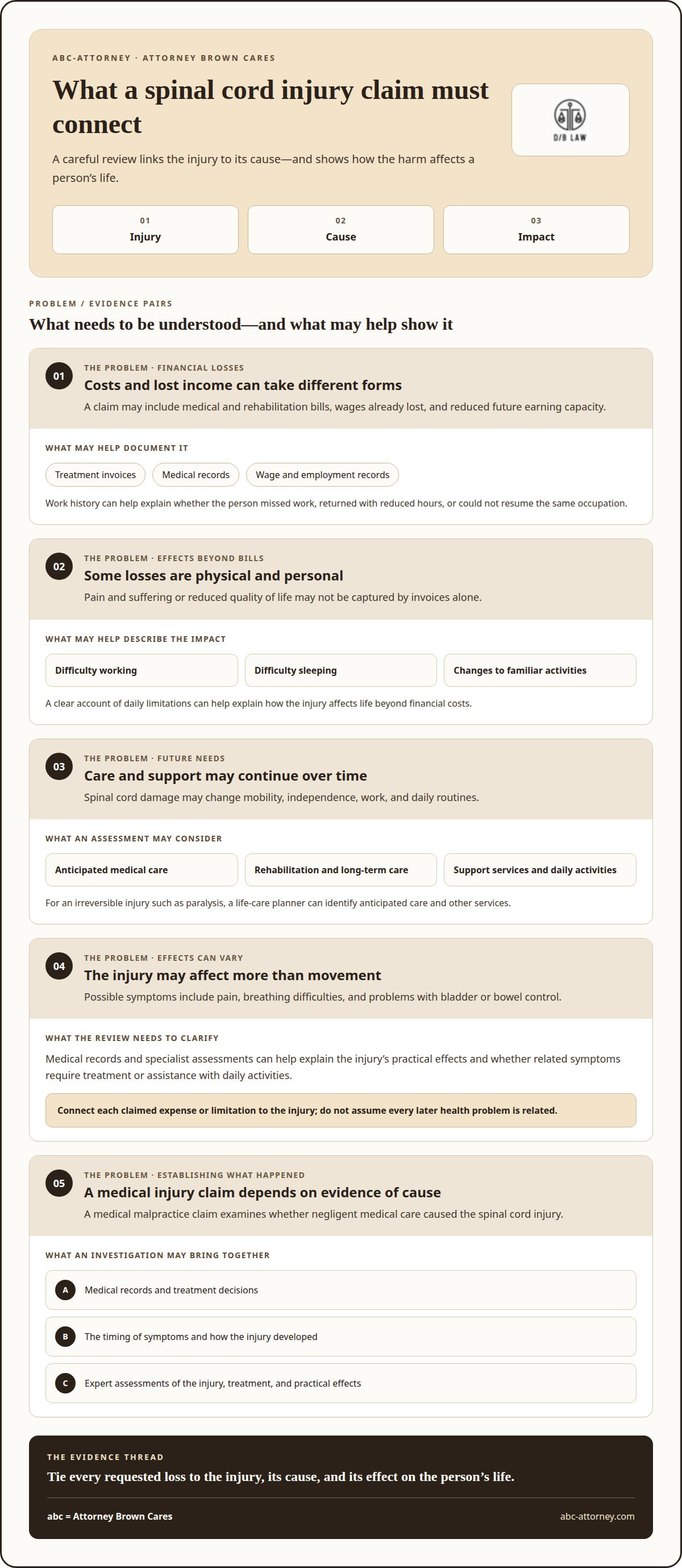
Compensation may address financial losses and the physical effects of spinal cord damage. Each requested category should be tied to evidence about the injury, its cause, and its impact on the person’s life. At abc-attorney, “abc” means “Attorney Brown Cares,” reflecting our personal care for clients.
Economic and Noneconomic Losses
Economic losses may include medical and rehabilitation bills, wages already lost, and reduced future earning capacity. Treatment invoices and employment documents can help show how these losses developed. Noneconomic damages may address pain and suffering or reduced quality of life. Evidence of difficulty working, sleeping, or taking part in familiar activities can describe effects that a bill alone cannot capture.
Compensation depends on the harm and the evidence supporting each loss. A claim may seek payment for medical and rehabilitative services, lost wages, decreased earning potential, pain and suffering, and reduced quality of life. In a wrongful death case, eligible family members may seek damages related to funeral and burial expenses, subject to applicable law.
Medical records can show the treatment received, while wage records can document time away from work. A personal injury lawyer can organize these materials to explain how the injury affected the person financially and physically. For example, returning to work with reduced hours may involve a different loss than an extended absence followed by an inability to resume the same occupation.
Future Quality of Life
Future quality of life matters because spinal cord damage may change mobility, independence, work, and daily routines. An evaluation can consider anticipated care, rehabilitation, and support services, as well as activities the injured person can no longer perform or can manage only with difficulty. For an irreversible injury such as paralysis, a life-care planner can identify anticipated medical care, long-term care, and other services.
Filing deadlines vary by state. The applicable deadline can depend on the claim type and defendant, so the rules for the state where the claim is brought need to be assessed.
After an accident, a lawyer can identify potentially responsible parties, gather records, and organize evidence of injury-related losses. The review may compare treatment documents with employment history and information about daily limitations. This can help separate expenses and losses tied to the spinal injury from unrelated costs.
The value of a claim also depends on evidence about responsibility. New York applies comparative-fault rules in injury cases, but the law governing a Texas claim must be assessed under the rules applicable there. A lawyer can examine the available evidence about the accident and each party’s conduct when evaluating how responsibility may affect recovery.
Recoverable damages, including medical care and lost wages
A spinal cord injury can create needs that continue long after emergency treatment ends. A claim may seek compensation for medical care, rehabilitation, lost wages, reduced future earning capacity, and other losses connected to the injury. Each category needs supporting evidence. Treatment records, employment documents, and a clear account of daily limitations can show how the injury affected the person.
Future medical care and life-care costs are assessed by identifying anticipated treatment, long-term care, and related services. For an irreversible injury such as paralysis, a life-care planner can outline those needs. Lost-income analysis considers wages already missed and whether the injury has reduced the person’s future ability to earn. Medical records and work history help establish the basis for each calculation.
Spinal damage may affect functions beyond movement. Symptoms can include pain, breathing difficulties, and problems with bladder or bowel control. These effects may require additional treatment or assistance with daily activities. Evidence should connect each claimed expense or limitation to the injury, rather than assuming every later health problem is related.
Access to appropriate rehabilitation can shape recovery and future care needs. People with spinal cord injuries may need rehabilitation at a hospital specializing in spinal cord injuries. A lawyer can review the treatment plan and records to understand the care provided and the ongoing services identified by a life-care planner. Medical specialists can assess the injury and explain its practical effects.
Medical experts can help clarify complex diagnoses, treatment options, and long-term limitations. A lawyer may coordinate a review by relevant specialists, such as orthopedists or neurosurgeons, and help identify support groups that address the person’s needs. An expert can explain how a spinal injury relates to a proposed treatment plan, while a support group may offer peer connection during recovery.
Medical malpractice claims examine whether negligent medical care caused the injury. Birth injury cases may involve different records and medical circumstances, including complications during delivery. In either situation, an investigation can compare records, treatment decisions, and the timing of symptoms. A consultation can help organize the questions and evidence relevant to a personal injury claim.
At abc-attorney, “abc” means “Attorney Brown Cares.” Attorney Brown cares about clients and provides personal attention to their needs. For a focused review of medical records, future care, and wage losses, request a case consultation. Bring available treatment and employment records if you have them; those documents can help frame the discussion around concrete needs and the injury’s effects on quality of life.
Incomplete and complete spinal cord injuries
After an accident or other trauma, clinicians assess where the spinal cord was damaged and which functions changed. Complete or incomplete classification, the injury level, and resulting limitations help explain the harm in an injury case. At abc-attorney, “abc” stands for “Attorney Brown Cares,” reflecting our personal care for clients.
The spinal cord carries information between the brain and body, so damage can affect sensation, muscle movement, motor control, and autonomic functions. Records may classify an injury as complete or incomplete based on preserved function below the injury. That classification alone does not describe every consequence. Two people with injuries at similar levels may have different symptoms and care needs.
Location matters. The spinal column includes seven cervical vertebrae in the neck, 12 thoracic vertebrae in the chest, and five lumbar vertebrae in the lower back. More than half of spinal cord injuries occur in the cervical region, while a third occur in the thoracic region. The specific level can help explain which areas of the body are affected.
Damage in the cervical region may affect the arms and legs. Quadriplegia describes some form of immobility in all four extremities, while paraplegia describes immobility in two extremities. Paraplegia may involve paralysis below the waist, affecting the legs, hips, and sexual, urinary, and bowel functions. These terms describe serious effects, but medical findings and daily limitations provide a fuller picture.
Symptoms can include loss of touch sensation, balance or movement problems, bladder and bowel control issues, changes in sexual function, pain, and breathing difficulties. A person may retain some sensation yet have substantial balance problems or ongoing pain. A careful assessment records each limitation rather than relying on one diagnosis to represent the entire injury.
In an injury case, medical documentation can connect the accident or trauma, diagnosed spinal damage, and resulting functional changes. Imaging and neurological findings may clarify the injury’s location and severity. Orthopedists and neurosurgeons can assess spinal injuries and possible treatments. Their assessments can distinguish documented effects from assumptions and show how the injury has altered movement, sensation, or independence.
A complete or incomplete classification does not, by itself, measure recovery or future quality of life. The analysis should also consider the person’s symptoms, treatment needs, and affected activities. Records describing difficulty walking, persistent pain, or changes in bladder control offer distinct examples of how spinal damage affects daily life. These details help present the impact of a devastating injury with precision.
How spinal cord injury lawyers investigate and handle claims
At abc-attorney, “abc” stands for “Attorney Brown Cares,” reflecting our personal care for clients. A spinal cord injury lawyer builds a claim by connecting the incident, potential negligence, and documented harm. The investigation begins with a timeline: what happened, when symptoms appeared, and how treatment unfolded. A catastrophic injury attorney for spinal cord damage can organize these facts and identify evidence that supports or challenges the account.
Medical records, accident documents, and witness information answer different questions. Treatment notes and imaging describe the injury; photographs, incident reports, and witness statements may help show how an accident occurred. A lawyer can compare these materials to identify gaps or inconsistencies. For example, a timeline showing when numbness was first reported may help explain how symptoms developed after a collision.
Claim value depends on evidence of responsibility and the injury’s consequences. A lawyer evaluates medical needs, lost income, reduced earning capacity, and changes to daily activities. The attorney also examines whether the available evidence links the defendant’s conduct to the spinal damage. A catastrophic injury attorney for spinal cord damage should explain how these factors shape the legal strategy, without treating any one document as conclusive.
Vehicle claims involve more than the collision description. A lawyer can review available insurance information, vehicle records, photographs, and statements to identify relevant coverage and potential parties. Medical documentation can establish the injury’s effects, while employment records may support wage-loss calculations. The legal approach depends on the crash circumstances, evidence, and applicable insurance and liability rules.
Claims involving a government body require particular attention to the rules that apply to that defendant and claim. An attorney identifies the responsible public entity, reviews incident records, and assesses applicable notice and filing requirements. These requirements can differ from those for claims against private parties, so identifying the defendant early helps guide the investigation and preserve the proper legal path.
When choosing an attorney, look for experience evaluating serious spinal injuries and a clear explanation of the investigation. Ask who will review the medical evidence, how the lawyer will assess causation, and how you will receive updates. A useful answer should connect the proposed steps to the facts of your injury, not rely on broad claims about results.
In a catastrophic injury case, the lawyer coordinates evidence from medical providers, witnesses, and other relevant sources. The lawyer can assess whether negligence caused the injury, organize proof of losses, and prepare the claim for negotiation or litigation. This approach presents the full effects of spinal cord damage while keeping the case grounded in verifiable evidence.
Hudson Valley spinal cord injury legal representation
Hudson Valley spinal cord injury cases need a clear account of the accident, treatment, and lasting effects. A local legal review should connect those details to New York personal injury law, identify responsible parties, and build the claim around reliable evidence. The region matters because the incident location, medical providers, witnesses, and potential defendants all shape the investigation.
To find an attorney near you, look for a law firm that handles serious personal injury cases and can explain its investigation process. At abc-attorney, “abc” means “Attorney Brown Cares,” reflecting our personal care for clients. Ask who will review medical records, how the firm evaluates paralysis and future care needs, and how it will communicate about evidence and decisions.
Strong representation starts with assembling records from the places and people involved. A lawyer can review the accident report, available photographs, witness accounts, and treatment records, then compare them with the timeline of symptoms and diagnoses. In a collision, vehicle damage and witness descriptions may help explain how the impact occurred. In a possible medical malpractice case, treatment records and specialist review can help assess whether care caused the spinal injury.
Geography also affects practical case preparation. A Texas investigation may involve coordinating records from multiple treatment locations and identifying witnesses connected to the incident site. The attorney should explain how each source relates to the claim, rather than treating a diagnosis alone as proof of responsibility. Records showing paralysis establish a serious condition; separate evidence must address how the injury happened and who may be legally responsible.
During a consultation, ask how the lawyer will assess three connected issues: fault, medical causation, and the injury’s effects. A direct answer should explain which evidence supports each issue and what questions remain for investigation. Ask how the lawyer handles disagreements between medical records and witness accounts, and how updates will reach you. Clear explanations make complex decisions more manageable.
A law firm’s approach should account for the full course of treatment, not just the first hospital visit. Follow-up care, rehabilitation, pain, mobility changes, and effects on work can all inform the claim. The lawyer should explain how medical specialists assess the spinal injury and how documented changes in daily activities support the legal analysis. Each claim needs evidence tied to its own facts.
Hudson Valley residents facing spinal cord damage can use these questions to assess whether an attorney’s process fits their needs. A focused review can clarify how an accident or medical treatment relates to the injury, what evidence should be preserved, and how the case may proceed. For a case-specific discussion, contact the legal team to discuss the incident, treatment, and questions that matter to your claim.
The Dedric Brown Law Firm
The Dedric Brown Law Firm helps people assess complex injury claims and understand the evidence behind them. If a spinal cord injury followed a truck wreck or auto wreck, a careful review can examine how the crash occurred, what medical records show, and how the injury affected daily life. The firm also handles traumatic brain injuries, hypoxic and anoxic brain injuries, and birth injuries.
Attorney Brown Cares is the meaning behind ABC: personal attention matters throughout the legal process. If you’re considering whether an accident-related injury may support a claim, a conversation can help clarify the questions and records relevant to your situation.
Contact The Dedric Brown Law Firm to discuss your circumstances.
Take the next step with clarity
A spinal cord injury can reshape daily routines, relationships, and plans for the future. You don’t have to sort through the legal questions alone. A conversation with a catastrophic injury attorney for spinal cord damage can help you understand how the circumstances, medical evidence, and lasting effects may fit together in a claim.
The Dedric Brown Law Firm, abc-attorney, stands for “Attorney Brown Cares”, a commitment to personal attention and care. You can explain what happened, raise your concerns, and discuss the questions that matter to you without pressure.
Contact The Dedric Brown Law Firm to discuss your circumstances. A thoughtful conversation can help you consider your next step with greater confidence.
Frequently Asked Questions
Can I bring a claim if the injury came from medical treatment?
Yes, a claim may be possible if negligent medical care caused the spinal cord injury. The analysis examines treatment decisions, medical records, and whether the care caused the harm. In New York, a medical malpractice claim generally must be filed within two years and six months of the act or the end of continuous treatment under CPLR 214-a. A lawyer can assess how the treatment timeline applies to the claim.
How Can a Spinal Injury Attorney Help?
A spinal injury attorney can investigate how the damage occurred, identify potentially responsible parties, and organize evidence linking the event to the injury. The attorney can explain legal options and handle communications related to the claim. At abc-attorney, “abc” means “Attorney Brown Cares”, a commitment to personal, client-centered care. The Dedric Brown Law Firm serves people across Texas, including Houston, San Antonio, Dallas, Austin, Beaumont, Huntsville, Prairie View, and Brenham.
What if I was partly at fault for the accident?
Being partly at fault doesn’t always prevent recovery in New York. In general, New York applies pure comparative fault, which reduces recovery according to the injured person’s assigned share of fault. For vehicle injury actions commenced on or after May 26, 2026, CPLR 1411(b) bars recovery if the injured person’s share of fault is greater than that of the people sued. The action’s filing date and facts matter.
Will I owe anything up front?
The Dedric Brown Law Firm offers a free case review and states, “You Pay Nothing Unless I Win Your Case!” This describes the firm’s contingency-fee model. Before retaining an attorney, review the written fee agreement carefully so you understand its terms and how case expenses are handled.
How much does a spinal cord injury lawyer cost, and do they charge a contingency fee?
The Dedric Brown Law Firm states that it uses a contingency-fee model, so no fee is owed unless it wins the case. The agreement should explain the fee terms and how case expenses are handled. Don’t assume every lawyer uses the same arrangement. Ask for clear explanations of the written terms before signing, including what happens if the claim resolves through settlement rather than trial.
What compensation can you recover for a spinal cord injury lawsuit?
A claim may seek compensation for documented medical care and rehabilitation, wages already lost, reduced future earning capacity, pain, and effects on daily activities. The evidence should connect each claimed loss to the injury. Treatment invoices can document billed care, while employer records can show missed work. A careful damages analysis distinguishes losses already incurred from future needs supported by medical evidence.
What is the average settlement for a spinal cord injury case, and what affects the amount?
There is no single settlement figure for every spinal cord injury case. The amount depends on the injury’s effects, evidence of fault, documented care needs, lost income, and the harm’s impact on daily life. The strength of the evidence also matters, including whether records consistently connect the incident to the injury. A prior result cannot determine what another person’s claim is worth.
What evidence is needed to prove fault and damages in a spinal cord injury claim?
Useful evidence can include medical records, imaging, treatment bills, accident reports, photographs, witness accounts, and employment records. A timeline can show when symptoms began and how treatment followed. For a medical treatment claim, records about the care and sequence of events can help explain the alleged connection. Keep relevant documents together and provide copies to the attorney reviewing the claim.


Comments