
Health Insurance Subrogation: How Much of Your Settlement Could Go to Repayment

Could health insurance take part of your personal injury settlement after the at-fault party pays? Yes. In a health insurance subrogation claim tied to a personal injury settlement, an insurer may seek repayment for accident-related medical bills it covered. But its demand is not automatically the amount you owe. Plan terms, applicable law, and the details of your claim can affect what is recoverable.
It is understandable to focus on the settlement amount and worry about how much will remain after medical bills and other deductions. An insurer’s claim can affect your final recovery, but the demand may be reviewable, and a lien reduction may change what you keep.
This article explains subrogation, how insurers seek repayment from settlement funds, and what factors can affect the amount. It also explains why the type of health plan matters and how reviewing the claim can clarify the financial picture before a settlement is finalized.
Table of Contents
How are Medical Bills Paid in a Personal Injury Case?
After an accident, medical expenses may be paid through health insurance, auto coverage, workers’ compensation, or a medical lien. If another party caused the injury, an insurer or provider may seek repayment from the recovery.
Examples of Subrogation in Injury Claims
Subrogation allows an insurer to seek reimbursement from a third party for covered injury expenses. It matters because a settlement may need to address both the injured person’s losses and claims related to bills already paid.
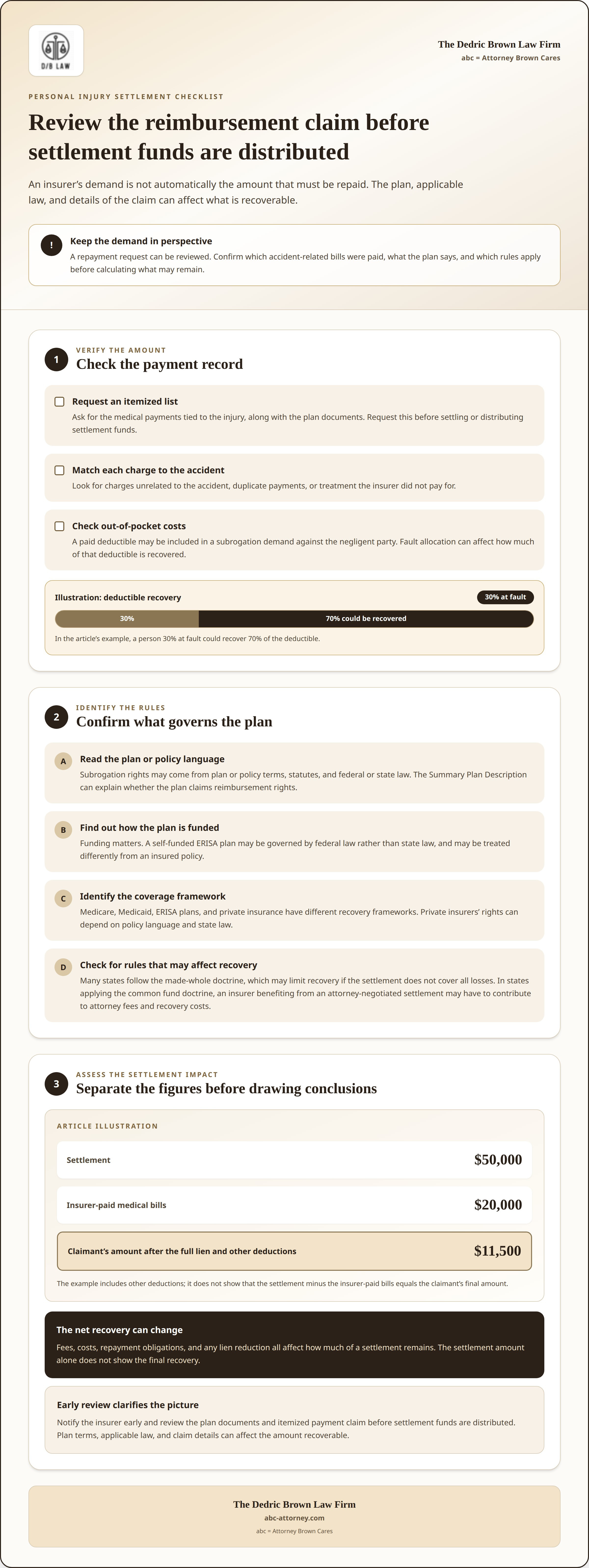
For example, after a car accident, health insurance might pay for emergency care, then seek reimbursement from a settlement with the at-fault driver. Similar claims can arise after a slip and fall, a workplace accident involving third-party negligence, or a dog bite. In one illustration, a $50,000 settlement and $20,000 in insurer-paid medical bills left the claimant $11,500 after the full lien and other deductions.
Reimbursement Claims Against At-Fault Parties
A reimbursement claim against an at-fault party seeks recovery from the person or insurer responsible for the injury. This differs from collecting directly from the injured person, even though an insurer may later seek repayment from settlement funds.
Health, auto, and workers’ compensation insurers may seek reimbursement when an injured person recovers compensation from the responsible party. For example, an auto insurer that paid for accident treatment under medical payments coverage may seek reimbursement from the other driver. A workers’ compensation insurer may also pursue a third-party settlement for medical expenses, lost wages, and other compensation when another party’s negligence contributed to a worker’s injury.
Recovering a Deductible
Deductible recovery means including the amount the injured person paid out of pocket in a subrogation claim against the negligent party. This matters because the insurer’s recovery can affect whether the claimant gets back some of their own accident-related expenses.
A health insurer must include a paid deductible in its subrogation demand to the negligent party. In an example where the injured person was 30% at fault, they could recover 70% of the deductible. The example shows why fault allocation can affect the amount returned, rather than leaving the full deductible with the injured person.
Negotiating or Challenging Reimbursement Claims
Negotiating or challenging a reimbursement claim means reviewing its basis and amount before settlement funds are distributed. An itemized statement can reveal charges unrelated to the accident, duplicate payments, or treatment the insurer did not pay for.
Request the plan documents and an itemized list of injury-related payments before settling. An insurer’s demand is not automatically the amount owed. Plan language, applicable law, and claim details can all matter. In states that apply the common fund doctrine, an insurer benefiting from an attorney-negotiated settlement may have to contribute to attorney fees and recovery costs. That contribution can reduce the reimbursement claim and affect the claimant’s net recovery.
Must I Repay Health Insurance After My Settlement?
Repayment depends on the health plan’s terms, benefits paid, and rules governing the injury claim. A settlement does not automatically make every dollar an insurer demands payable.
Sources of Subrogation Rights
Subrogation rights may come from plan or policy language, statutes, and federal or state law. Their source matters because it helps determine which rules apply to repayment from injury compensation.
According to U.S. Congress, ERISA is the Employee Retirement Income Security Act of 1974. Many employer-provided health plans are generally likely to qualify, though exceptions exist. The Summary Plan Description can explain whether the plan claims reimbursement rights. Funding also matters: a self-funded ERISA plan may be governed by federal law rather than state law, and may be treated differently from an insured policy.
Health Insurer Recovery Rights
Health insurance subrogation allows a carrier to seek repayment for covered treatment when another party caused an injury. The plan’s terms and applicable law matter because an insurer’s demand alone does not establish the recoverable amount.
Medicare, Medicaid, and private insurance have different recovery frameworks. Medicare has strong federal collection powers under the Medicare Secondary Payer Act. Medicaid and ERISA plans have their own rules, while private insurers’ rights can depend on policy language and state law. The type of coverage, the payments related to the accident, and the settlement terms all shape the reimbursement analysis.
Federal and State Variations
Federal and state rules can lead to different recovery outcomes in an injury claim. That distinction matters when assessing whether a plan can seek repayment and whether a reduction may apply.
ERISA governs many employer health plans, but state doctrines may treat self-funded ERISA plans differently. Many states follow the made-whole doctrine, which may limit an insurer’s recovery if a settlement does not cover all the injured person’s losses. Medicare and Medicaid follow separate reimbursement rules, and reductions may sometimes be possible. Plan funding, governing language, and the law applicable to the claim all affect the analysis.
Deadlines and Notice Requirements
Notice and timing requirements depend on plan terms and applicable law. Notifying the insurer early can help identify accident-related payments before settlement funds are distributed.
Request plan documents and an itemized list of medical payments tied to the injury. A plan administrator has to respond to a request for plan documents and a detailed list of medical payments within 10 days by certified mail. Keep records of notices, responses, and disputed charges. Those records help distinguish injury-related treatment from unrelated care and clarify the basis for a reimbursement demand. For help understanding how plan language and recovery rules affect your settlement, discuss your injury settlement.
How health insurers seek reimbursement from personal injury settlements
A health insurer may seek repayment from settlement funds for medical bills it paid after an injury. The amount depends on the accident-related payments, plan terms, and any applicable reductions.
Reimbursement After a Settlement
Reimbursement is repayment to an insurer from money recovered in a personal injury case. The insurer’s claim can affect how much of the settlement remains after other deductions.
The process often begins when an insurer learns about the injury claim and identifies benefits paid for treatment. It may assert a claim against a settlement with the party responsible for the accident. Health insurers are not the only potential claimants: Medicare, Medicaid, auto insurers, workers’ compensation insurers, and self-funded ERISA plans may also seek repayment, depending on the coverage and circumstances.
Calculating the Amount Owed
The amount generally starts with medical payments connected to the injury, then depends on the plan language and applicable law. This calculation matters because a demand may include charges that do not belong in the injury case.
An itemized payment statement helps distinguish those charges from accident-related medical bills. The analysis can also consider whether a plan or state rule allows a reduction for attorney fees or recovery costs. An insurer’s stated total is a claim to examine, not automatically the final repayment amount.
Effects on Settlement Proceeds
Reimbursement reduces the amount left for the injured person after settlement deductions.
The arithmetic makes the stakes clear: reducing a reimbursement demand can preserve more of the recovery, while an unresolved claim can complicate distribution of the funds.
Consequences of Nonpayment
Nonpayment means the asserted reimbursement claim remains unresolved after settlement. That can create financial and legal exposure, particularly when Medicare or Medicaid has an interest in the recovery.
Failure to address Medicare or Medicaid subrogation claims can result in double damages and interest. Other plan or policy terms may also provide a basis for pursuing repayment. Before distributing settlement proceeds, identify, review, and resolve the claim under the applicable rules. Clear accounting of insurer payments and negotiated reductions can help prevent a repayment dispute from arising after the injury case closes.
Negotiating lien reductions
Before accepting a settlement, identify each reimbursement claim, match it to payments for injury-related treatment, and review the governing plan terms. These steps help establish what the lien covers and which reduction arguments may apply.
Preparing Before Settlement
Preparation means gathering records that let you evaluate an insurer’s claim before settlement terms are final. The review matters because the lien can affect the funds available for your recovery.
Gather the plan documents and an itemized payment statement. Match each listed service to the accident and treatment records. Separate unrelated care, duplicate entries, and expenses for a condition not caused by someone else’s negligence. Then identify the payer and plan type, such as private insurance, Medicare, Medicaid, or an ERISA plan. Each may involve different reimbursement rules.
An experienced attorney can also assess how fees and costs incurred to obtain the recovery affect the claimed amount. In some states, the common fund doctrine requires an insurer benefiting from an attorney-negotiated settlement to contribute to attorney fees before recovering on its subrogation claim. Whether that doctrine applies depends on the governing law and plan. Accounting for those costs before distribution can clarify the insurer’s potential net recovery.
Negotiating Subrogation Liens
Negotiating a subrogation lien means supporting a request to repay less than the insurer initially demands. A successful reduction can leave more of the settlement available to the injured person.
Build the request around the records, settlement, and applicable plan language. Consider whether the settlement fully compensates the losses and whether governing law supports a reduction. In states that apply the made-whole doctrine, it may affect when an insurer can assert recovery rights. A self-funded ERISA plan may be treated differently, so its funding structure and terms deserve careful review.
For illustration, reducing a $20,000 lien to $10,000 doubles the claimant’s take-home amount if other deductions remain unchanged. This example shows how a negotiated reduction can affect the net recovery. It does not establish what a particular insurer must accept.
Negotiating Reimbursement Amounts
Negotiating the reimbursement amount means challenging the calculation with specific records. That matters because a demand may include expenses that do not belong to the injury claim.
Compare the itemized demand with medical records and payment details. Flag care predating the accident, duplicate payments, or charges for a chronic condition unrelated to the accident. Then calculate the requested repayment after any applicable fee contribution or plan-based adjustment. ERISA plan terms may differ from state-law rules, so do not assume one doctrine governs every claim.
Keep any counterproposal tied to the evidence and applicable rules. A clear accounting focuses negotiations on disputed payments rather than an unsupported total. For help reviewing a lien connected to your injury claim, discuss your settlement options.
Health insurance subrogation
Subrogation gives an insurance company a way to pursue repayment from a responsible party after covering injury-related care. For an injured person, the key question is not simply whether the insurer can collect, but what the plan or law permits it to recover from a settlement.
The process has two linked parts: the insurer asserts subrogation rights, and the injured person’s recovery is reviewed for repayment. A lawyer can compare the demand with the plan terms, payment records, and settlement details. That review matters because an insurer’s assertion does not automatically establish that every listed charge relates to the accident or that the full amount is recoverable.
In Sereboff v. Mid-Atlantic Medical Services, Inc., the Supreme Court of the United States decided the case in 2006, at 547 U.S. 356. The case is an important reference point for understanding reimbursement disputes involving health plans. Its citation alone does not answer every claim: plan language, the type of coverage, and the facts of the injury case still shape the repayment analysis.
Different payers can assert different recovery interests. A private health insurance company may seek repayment under its plan terms. Medicare has collection powers under the Medicare Secondary Payer Act, while Medicaid and self-funded ERISA plans have their own rules. An auto insurer may also seek reimbursement for accident treatment paid under medical payments coverage. Identifying each payer helps prevent separate claims from being mistaken for one combined lien.
Someone else’s negligence may create the third-party recovery that triggers a subrogation claim. For example, after a crash, an insurer may pay emergency treatment bills and later seek repayment from funds recovered from the responsible driver. The settlement must then be assessed alongside the insurer’s payment history and the applicable plan provisions. The practical takeaway is to trace each demand to the benefits paid and the rules governing that payer.
A lawyer reviewing a disputed claim can examine whether charges are accident-related, whether payments were duplicated, and whether the recovery calculation accounts for applicable reductions. Medicare, Medicaid, private policies, and ERISA plans should not be treated as interchangeable. Understanding the distinction before funds are distributed can help clarify what the insurer may claim and what remains for the injured person. For legal help with an injury claim and its repayment demands, contact an attorney about your settlement.
The Dedric Brown Law Firm: Personal Injury Litigation
The Dedric Brown Law Firm handles personal injury litigation when an injury claim involves a settlement and an insurer’s repayment demand. If medical bills, liability, and a lien affect what you may keep, legal guidance can bring those connected issues into focus. This is especially important in serious cases involving traumatic brain injuries, hypoxic and anoxic brain injuries, or birth injuries, where the injury claim itself can be complex. The firm’s ABC commitment means Attorney Brown Cares, with attention to the person behind the case as well as its legal and financial details. Contact The Dedric Brown Law Firm for a free case review of your injury claim and settlement concerns.
Plan Your Next Move With Confidence
A settlement decision affects more than the amount available today. Consider how your recovery fits your ongoing needs, especially if an injury has changed your health, work, or family life. Understanding a health insurance subrogation claim within a personal injury settlement can help you approach that decision with a clearer view of your financial position.
The Dedric Brown Law Firm, abc-attorney, is guided by its ABC commitment: “Attorney Brown Cares.” The firm handles personal injury litigation involving traumatic brain injuries, hypoxic and anoxic brain injuries, and birth injuries. The firm’s client-centered approach keeps your circumstances and concerns in focus. You deserve a thoughtful review of the issues shaping your recovery, without pressure or promises about the outcome.
When you’re ready to discuss your situation, contact The Dedric Brown Law Firm. Take the next step at your own pace, with your questions at the center of the conversation.
Frequently Asked Questions
What Is Subrogation?
Subrogation is an insurer’s effort to recover from a responsible third party after paying covered losses. For example, after a collision, a health insurer may pay for treatment and then seek reimbursement from a recovery involving the at-fault driver. The insurer’s claim concerns payments it made; it does not automatically determine the value of the injured person’s separate claims for pain, lost income, or other damages.
What is the “Made Whole” Doctrine?
The made-whole doctrine generally concerns whether an injured person must be fully compensated for losses before an insurer can assert subrogation rights. Its effect varies with the governing law and plan. In Pennsylvania, the doctrine generally gives an injured person full compensation for losses before an insurer asserts those rights. If a settlement leaves substantial losses uncompensated, the doctrine may affect the insurer’s recovery, depending on the applicable rules.
What does subrogation mean in health insurance?
In health insurance, subrogation means an insurer may seek repayment for covered care when someone else caused the injury. For instance, if a health plan paid hospital charges after a fall, it may claim a portion of a later recovery connected to that event. The key distinction is between all medical care received and the specific benefits the plan actually paid for the injury.
What does ERISA mean and why is it important?
ERISA is the Employee Retirement Income Security Act of 1974, according to U.S. Congress. It matters because federal law governs many employer-provided health plans, and a plan’s reimbursement terms can affect what it seeks from an injury recovery. Self-funded ERISA plans may be treated differently from insurance policies regulated under state law. The Summary Plan Description can help identify the plan’s stated terms and asserted recovery rights.
Does my health insurance qualify as an ERISA plan?
An employer-provided health plan is generally likely to qualify as an ERISA plan, though exceptions exist. The employer’s involvement alone does not answer every question; whether the plan is self-funded or insured can also matter. Review the Summary Plan Description and plan documents for information about funding and reimbursement provisions. Those details help distinguish a plan governed by federal rules from coverage subject to state-law doctrines.
Can I be sued for not paying a subrogation claim?
Yes, a lawsuit is possible in some circumstances. In Georgia, a personal injury victim can be sued for failing to reimburse health insurance under a subrogation claim. That example should not be assumed to describe the rules in every state. The plan language, type of coverage, applicable law, and validity of the demand all matter. Ignoring a claim can leave a dispute unresolved after settlement funds are received.
What Is Subrogation and How Will It Affect My Personal Injury Claim?
Subrogation is a potential repayment claim against a recovery, so it can affect the amount remaining after settlement. It does not replace your claim against the party responsible for the injury. For Texas injury claims arising in Houston, San Antonio, Dallas, Austin, Beaumont, Huntsville, Prairie View, or Brenham, plan terms and applicable law still need careful review. Consider the insurer’s claim alongside the losses the settlement is meant to address.
What is health insurance subrogation in a personal injury settlement?
It is an insurer’s claim to recover qualifying medical benefits from settlement funds connected to an injury. For example, a plan may identify payments for accident-related treatment and assert a reimbursement interest when the claim resolves. Before accepting a final distribution, understand which payments the demand covers and what plan provisions support it. That review helps distinguish the insurer’s asserted share from compensation intended for your other losses.



Comments