
Hypoxic Ischemic Encephalopathy Lawyer for Families

An HIE diagnosis can explain a child’s brain injury, but it does not establish what happened during labor and delivery. A hypoxic ischemic encephalopathy lawyer investigates whether delays or other preventable medical errors may have contributed to oxygen deprivation and injury. The review can also consider whether HIE is connected to cerebral palsy or other lasting effects.
It’s understandable to want clear answers while your family focuses on your child’s care. HIE and cerebral palsy can overlap, but understanding their relationship requires close review of the medical timeline and records.
This article explains what an HIE lawyer does, how a legal investigation reviews fetal monitoring and delivery records, and what evidence may matter in a birth injury claim. It also explains how an attorney assesses whether the facts support a malpractice case and helps your family understand possible next steps.
Table of Contents
How a lawyer can investigate liability
A liability investigation reconstructs what happened before, during, and after birth. A hypoxic ischemic encephalopathy lawyer compares the medical timeline with test results and care documented in hospital records.
Evidence for a Malpractice Claim
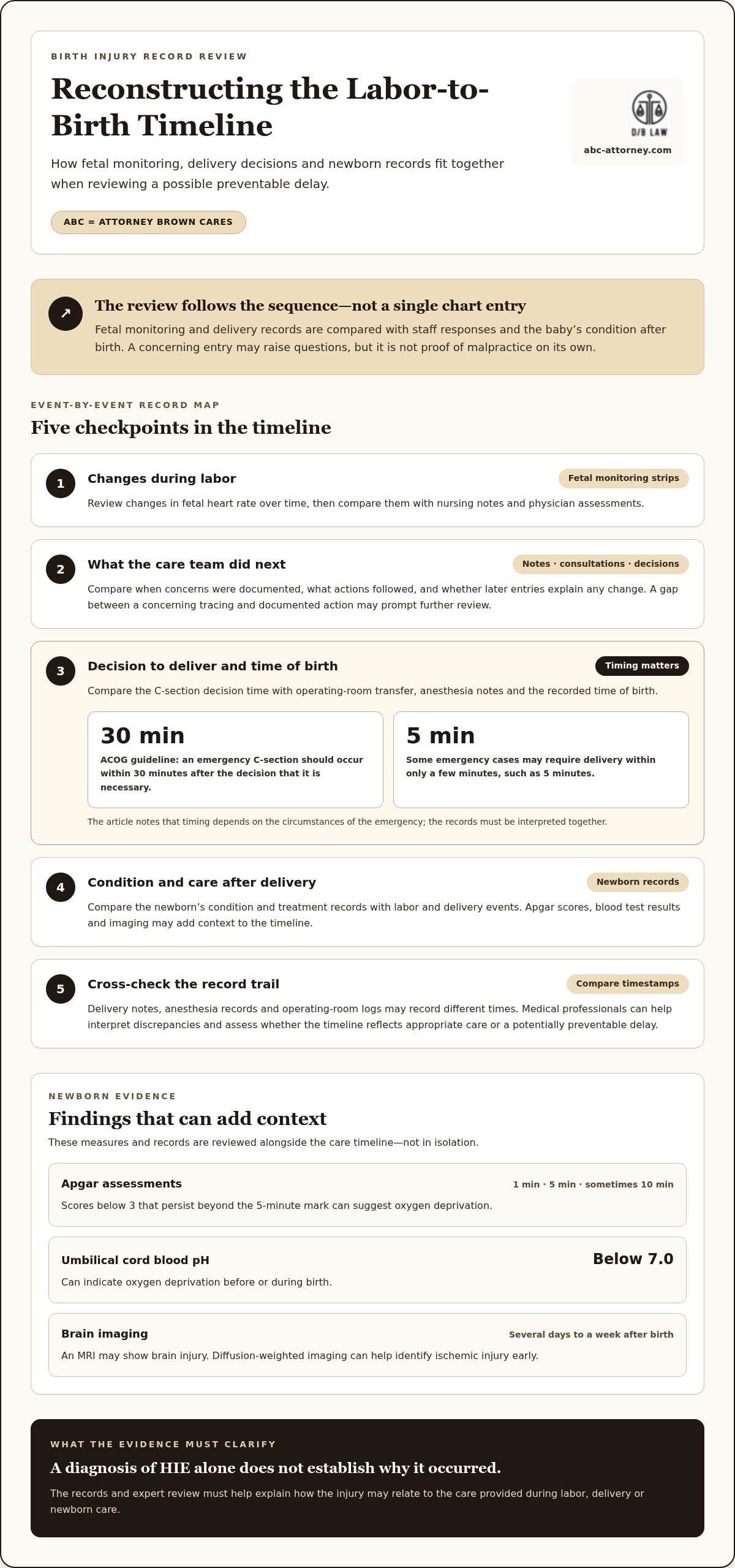
Start with records that show your baby’s condition and the medical team’s response. Apgar scores are assessed at 1 minute and 5 minutes after birth, and sometimes at 10 minutes when scores are low. Scores below 3 persisting beyond the 5-minute mark can suggest oxygen deprivation. An umbilical cord blood pH below 7.0 can also indicate oxygen deprivation before or during birth.
An attorney can seek hospital data and consult medical experts to assess how the records fit together. For example, an MRI performed several days to a week after birth may show brain injury, while diffusion-weighted imaging can help identify ischemic injury early. These findings can be compared with birth records and the newborn’s condition.
Medical professionals may assess whether documented concerns were recognized and addressed. An attorney can also examine clinical notes, test results, and treatment records for gaps or conflicting details. One entry might describe a newborn’s condition differently from a later note. Comparing timestamps and observations helps establish what the care team knew and when.
Some birth injury law firms use nurses with relevant experience to speak with families, review medical records, and assess possible errors during or shortly after birth. A legal investigation can also seek hospital data through subpoenas. Together, expert review and a detailed record timeline help assess whether medical negligence may have contributed to the injury.
Preparing to Contact an HIE Lawyer
Before contacting an HIE lawyer, write a brief timeline of labor, delivery, and newborn care, then gather the records you already have. Note the hospital, delivery date, diagnosis, and questions raised by medical professionals. You don’t need to decide whether an error occurred; clear dates and documents give the attorney a practical starting point.
Keep discharge papers, test results, and written communications together, and note who provided each document. If records are incomplete, list the hospital or clinic that holds them. A hypoxic ischemic encephalopathy lawyer can use that list to guide a records review and identify information that may clarify how oxygen deprivation occurred.
Write down the sequence of labor, delivery, and newborn treatment.
Collect available records, including Apgar scores and imaging results.
List your questions and any differences you notice between records.
These steps help keep the initial discussion focused on concrete details, such as a test result, a documented change in your baby’s condition, or the timing of treatment. Preserve original documents and keep your notes factual. The attorney can then assess what additional records and expert review may be needed to examine liability.
Investigating fetal monitoring and delivery records
Fetal monitoring and delivery records help reconstruct how a baby’s condition changed during labor. A birth injury lawyer compares recorded signs, staff responses, and delivery decisions to assess whether a delay may have contributed to oxygen deprivation or brain damage. The review focuses on the sequence of events, not one isolated entry.
Monitoring strips can show changes in fetal heart rate over time. An attorney may compare those patterns with nursing notes, physician assessments, and records showing when the care team responded. For example, a concerning tracing followed by a long gap before documented action raises questions about what staff observed and when. Medical experts can assess whether the response fit the clinical picture.
Timing matters in urgent delivery decisions. According to American College of Obstetricians and Gynecologists guidelines, an emergency C-section should occur within 30 minutes after the decision that it is necessary. Some emergency cases may require delivery within only a few minutes, such as 5 minutes. A review therefore examines the decision time, operating-room records, anesthesia notes, and the time of birth together.
Other records provide context. An attorney may compare labor progress notes with medication records, maternal conditions, and events involving the umbilical cord or placenta. If the chart describes fetal distress, the investigation asks what actions followed and whether later entries explain any change. This comparison can identify inconsistencies without treating a single chart phrase as proof of malpractice.
A focused review may organize the records around key events:
Changes shown in fetal monitoring strips and when staff documented them.
Recorded concerns, consultations, and decisions to expedite delivery.
The timing of a C-section decision, operating-room transfer, and birth.
Newborn condition and treatment records after delivery.
Each item can be checked against the rest of the timeline. A delivery note may record one time, while an anesthesia record or operating-room log records another. Those differences require careful interpretation. A law firm can work with medical professionals to assess whether the timeline reflects appropriate care or a preventable delay that may have contributed to the child’s injury.
A lawsuit requires more than proof that HIE occurred. The evidence must help explain how the injury relates to the care provided. An attorney can obtain hospital data and consult medical experts to evaluate that connection. Organizing available records and noting questions about specific events can make the review more focused.
If fetal monitoring or delivery timing raises concerns, you can discuss the birth records with an attorney. A careful timeline gives the conversation a clear starting point and helps identify what further review may be needed.
Hypoxic ischemic encephalopathy and cerebral palsy
Hypoxic-ischemic encephalopathy (HIE) describes brain injury when an infant’s brain doesn’t receive enough oxygen and blood. Cerebral palsy can be one lasting outcome of that injury, but an HIE diagnosis alone doesn’t establish how or when it occurred. A careful review connects the diagnosis, birth events, and the child’s development.
HIE is categorized as mild, moderate, or severe. About 30 percent of children with moderate-to-severe HIE develop cerebral palsy. This statistic describes a possible outcome, not a prediction for an individual child. The child’s medical records, neurological findings, and developmental history help explain the effects present in that specific case.
According to the American Academy of Pediatrics, an Apgar score of 5 to 7 at one minute may indicate problems during birth that lowered the baby's blood oxygen. Apgar scores provide a snapshot of a newborn’s condition; a low score alone doesn’t diagnose HIE. Doctors consider other clinical findings and tests, including imaging, when evaluating a newborn’s condition.
For families, the central question is how the medical timeline relates to the diagnosis. A review can compare labor and delivery records with newborn test results and later neurological assessments. For example, clinicians may consider MRI findings alongside records of fetal distress and the infant’s condition after birth. That comparison helps assess whether oxygen deprivation occurred around delivery.
HIE can also lead to seizures, developmental delays, and physical or intellectual disabilities. Depending on their individual challenges, some children may benefit from physical, occupational, or speech therapy. These needs can change over time, so follow-up care records may document effects on daily life, mobility, communication, and development.
Therapeutic hypothermia may be used after an HIE diagnosis to potentially improve outcomes, and should begin within 6 hours of birth under current guidelines. Treatment records can therefore help establish what care the newborn received and when. The timing and medical context matter; treatment alone doesn’t prove whether negligence caused an injury.
In a legal review, medical experts can examine whether the evidence supports a connection between care, HIE, and cerebral palsy. A claim may address the child’s documented needs and the effects of the injury. Settlements in other cases do not determine the outcome of a particular claim. The key is to evaluate the medical evidence alongside the child’s diagnosis, rather than treating HIE or one test result as conclusive.
What medical errors can cause HIE during labor and delivery?
HIE can occur when an infant’s brain receives too little oxygen and blood. During labor and delivery, several complications may disrupt that supply. Some are medical emergencies; others may involve failure to recognize a changing condition or respond appropriately. The key is how events unfolded and whether the care provided contributed to the injury.
Placental abruption can interrupt oxygen delivery before birth. Umbilical cord compression or another cord complication can also restrict blood flow. A difficult or prolonged delivery may create additional risks, particularly if the baby shows signs of distress. These conditions alone do not prove negligence. A careful review connects the medical circumstances with the team’s actions and the newborn’s condition.
Other possible causes include an infant airway blockage, inadequate blood circulation, premature birth, severe fetal anemia, extremely low blood pressure, and respiratory problems. Blocked or ruptured blood vessels can also affect the flow of oxygenated blood to the brain. Each mechanism differs. For example, an airway obstruction concerns breathing after birth, while cord compression may affect blood flow before delivery.
Placental or cord complications: Review records for signs of abruption, compression, or other problems.
Delayed delivery: Compare the documented concern with the decision and delivery timeline.
Newborn breathing or circulation problems: Examine resuscitation and post-delivery care records.
Maternal or fetal conditions: Consider how anemia, prematurity, or low blood pressure affected the clinical picture.
Delivery decisions require context. An emergency C-section may be considered when labor records show fetal distress or another urgent concern. The investigation examines when the concern arose, how it was documented, and what followed. It also compares the delivery record with newborn findings instead of treating one chart entry as conclusive proof of the cause.
Medical professionals may assess whether the response to a complication matched the circumstances. If records document a change in the baby’s condition, for instance, reviewers can trace subsequent assessments, interventions, and delivery decisions. They may compare those events with cord blood results, imaging, or newborn treatment records to evaluate whether oxygen deprivation occurred around birth.
HIE may be preventable and can result from medical malpractice, but not every HIE diagnosis reflects an error. The evidence must connect a specific act or omission with the injury. In a medical malpractice review, the practical focus is the documented sequence: complication, recognition, response, and the baby’s condition after delivery.
What evidence is needed for a birth injury malpractice claim?
A strong birth injury claim connects three things: the care provided, the child’s injury, and the resulting losses. No single chart entry proves the entire case. The evidence helps establish a timeline, then medical experts assess how each record fits that sequence.
Begin with the complete maternal and newborn medical records. These may include prenatal notes, labor and delivery documentation, fetal monitoring, medication records, resuscitation notes, and neonatal intensive care records. Together, they show what conditions were present, what staff recorded, and how care changed from pregnancy through newborn treatment. Missing pages or unexplained gaps may prompt further investigation.
Diagnostic evidence helps establish the nature and timing of an injury. Records may include umbilical cord blood results, neurological examinations, imaging, and notes documenting seizures or breathing difficulties. An MRI for HIE is typically performed several days to a week after birth. Diffusion-weighted imaging can help identify ischemic brain injury early. Experts interpret these findings alongside the clinical record, not in isolation.
Separate evidence can clarify what the care team knew and when. Hospital data, timestamps, and staff notes can be compared with test results and treatment decisions. An attorney can consult medical experts and subpoena hospital data while investigating a malpractice claim. Expert review helps explain whether the records support a connection between care and injury.
Evidence of the child’s ongoing needs documents the practical effects of an injury. Keep records of medical bills, therapy, assistive technology, and appointments. A parent’s lost wages from caring for a child may also be relevant. For example, therapy records and clinician notes can describe changes in mobility, communication, or daily support needs. These documents help organize the family’s losses around specific care and services.
A useful evidence file can include:
Pregnancy, labor, delivery, and newborn-care records.
Test results, imaging reports, and neurological assessments.
Follow-up care, therapy notes, and assistive technology records.
Medical bills and documentation of a parent’s missed work.
Keep copies in date order and note where each record came from. Write down questions about conflicting dates, missing entries, or changes in diagnosis. Don’t alter original documents. This organization helps an attorney and medical experts identify which additional records could clarify the sequence and causation.
Evidence supports a claim by telling a connected story, not by relying on one score or diagnosis. A focused review tests whether the medical timeline, expert interpretation, and documented effects align. Discuss your child’s birth injury evidence with an attorney to understand how those records can be evaluated.
The Dedric Brown Law Firm: Traumatic Brain Injuries
The Dedric Brown Law Firm handles traumatic brain injury, hypoxic and anoxic brain injury, and birth injury matters. If your child has an HIE diagnosis and the birth records raise questions about preventable medical errors, the firm can review the circumstances as a potential injury claim. The review focuses on the medical evidence and how the injury may affect your child.
Families deserve clear, careful attention while managing their child’s needs. The firm’s ABC message means “Attorney Brown Cares,” reflecting a commitment to personal care alongside focused legal advocacy. To discuss your family’s situation, contact The Dedric Brown Law Firm for a free case review.
Take the Next Step With Clarity
Your child’s care comes first. Legal questions can feel overwhelming alongside appointments, therapies, and daily decisions. You don’t need to resolve every question before seeking guidance. A focused conversation can help you understand what a legal review involves and decide what feels right for your family.
A hypoxic ischemic encephalopathy lawyer can listen to your concerns and explain how the facts of your family’s situation may be assessed. Bring the questions that matter most to you, including what to expect from a records review and how a potential claim could proceed. Clear answers can help you make an informed choice at your own pace.
When you’re ready to explore that next step, contact The Dedric Brown Law Firm. Your family deserves care, understanding, and room to move forward with confidence.
Frequently Asked Questions
What Is a Hypoxic-Ischemic Encephalopathy Lawyer?
A hypoxic ischemic encephalopathy lawyer evaluates whether medical care may have contributed to an infant’s brain injury. The lawyer gathers relevant records, consults medical experts, and assesses whether the evidence supports a claim. For families, the review can clarify possible legal options and next steps. The lawyer investigates and advocates; they don’t diagnose or treat the child.
How Serious is HIE?
HIE can have serious effects, but the impact varies with the degree of injury. Newborn cases are categorized as mild, moderate, or severe. For infants with severe HIE, the mortality rate is 25-50 percent. Children who survive may experience lasting developmental, intellectual, or physical challenges. Discussing your child’s diagnosis, current abilities, and support needs with their medical team can help you understand their individual situation.
How do I find the right attorney for my family?
Look for an attorney who handles birth injury and medical malpractice litigation and can explain how medical experts review neonatal records. Ask how the attorney will keep your family informed and assess evidence specific to your child’s situation. The Dedric Brown Law Firm represents families in birth injury and medical malpractice matters across Texas, including Houston, San Antonio, Dallas, Austin, Beaumont, Huntsville, Prairie View, and Brenham.
How long will an HIE birth injury case take to settle?
An HIE case timeline depends on the medical review, available records, complexity of causation, and whether the parties can resolve the dispute. Experts may need to assess the diagnosis and care needs before negotiations can meaningfully proceed. Disputed facts or litigation may add steps. Ask the attorney to explain the case’s current stage and which evidence or decisions could affect its progress.
What Compensation is Available in Florida HIE Cases?
Potential compensation may address documented losses related to a child’s injury, such as medical care, assistive technology, and a parent’s lost wages while providing care. Bills, treatment plans, and records of the child’s needs can help document those losses. The Dedric Brown Law Firm focuses on Texas, including Houston, San Antonio, Dallas, Austin, Beaumont, Huntsville, Prairie View, and Brenham. Florida-specific legal questions fall outside this Texas focus.
How can I tell if my child’s HIE was caused by medical malpractice?
An HIE diagnosis alone does not establish medical malpractice. A hypoxic ischemic encephalopathy lawyer can assess whether the records show a connection between medical care and the injury. Consider what the records say about complications, the care team’s response, and the newborn’s condition. Medical experts can compare those facts and assess whether the care may have contributed to the injury.
How much compensation can families recover in HIE lawsuits?
There is no single recovery amount for every HIE lawsuit. The value depends on evidence of the injury, its effects on the child, and documented losses. Another family’s settlement or verdict does not predict the result in your case. A careful assessment considers the child’s circumstances and supporting records rather than relying on headlines or an assumed average.
What damages can an HIE malpractice settlement cover, including lifetime care?
An HIE malpractice settlement may address documented medical bills, assistive technology, and a parent’s lost wages related to caregiving. If a child needs ongoing support, care plans and expense records can help show the services and equipment involved over time. Organizing those documents by date and type of need helps explain how the requested damages relate to the child’s circumstances.



Comments