
Labor and Delivery Malpractice: Birth Injury Signs and Causes

A difficult birth doesn’t automatically mean malpractice. Labor and delivery malpractice may occur when a healthcare provider fails to meet the accepted standard of care and that failure causes or contributes to harm to the baby or birthing parent. The key questions are what the care team did, what the circumstances required, and whether the response affected the outcome.
It’s understandable to seek answers when an injury appears after delivery. But a diagnosis alone doesn’t establish negligence. Pregnancy, labor, delivery, and newborn-care records need to be considered together to understand what happened.
This article explains birth injury medical negligence, how monitoring failures or delivery complications may cause harm, and what signs can raise questions about the care provided. It also covers when a hospital may be sued and why a connection between a provider’s conduct and an injury matters. The goal is to clarify the issues families may face after a birth injury.
Table of Contents
What is birth injury medical negligence?
Birth injury medical negligence occurs when a provider’s care falls below the accepted standard and causes harm. A difficult delivery or an injury alone doesn’t prove malpractice.
Medical Malpractice Standards of Care
The standard of care is the level of treatment that reasonably prudent, similarly qualified healthcare providers would consider acceptable in the circumstances. In pregnancy and delivery cases, the comparison is with what a competent provider in the same field would do in a similar situation. A labor and delivery malpractice claim must connect a specific departure from that standard to the injury.
For example, a review may examine whether a provider recognized a documented complication and responded appropriately. The question isn’t whether another choice was possible, but whether the care fell below the applicable standard and caused harm.
Labor and Delivery Staff Responsibilities
Doctors, nurses, and other labor and delivery staff care for both the birthing parent and baby. Their responsibilities may include monitoring conditions, recognizing complications, communicating changes, and responding to distress. A concerning fetal heart rate or a change in the mother’s condition, for instance, may call for reassessment and action.
Responsibility may involve an individual decision or a breakdown in communication, preparation, or staffing. Records can help establish who knew about a developing concern and what steps followed.
Medication and Delivery-Tool Errors
Medication errors may include giving Pitocin unnecessarily, using an excessive dose, or failing to stop it when maternal or fetal distress occurs. These details matter because Pitocin-induced contractions can disrupt a baby’s heart rate and oxygen level. A review considers why the medication was given, how staff monitored its effects, and whether an error caused injury.
Improper forceps or vacuum-extractor use may injure a baby’s face, brain, or nerves, or harm the birthing parent. The reason for assisted delivery, the technique used, and the resulting injury all matter.
Steps and Evidence for Families
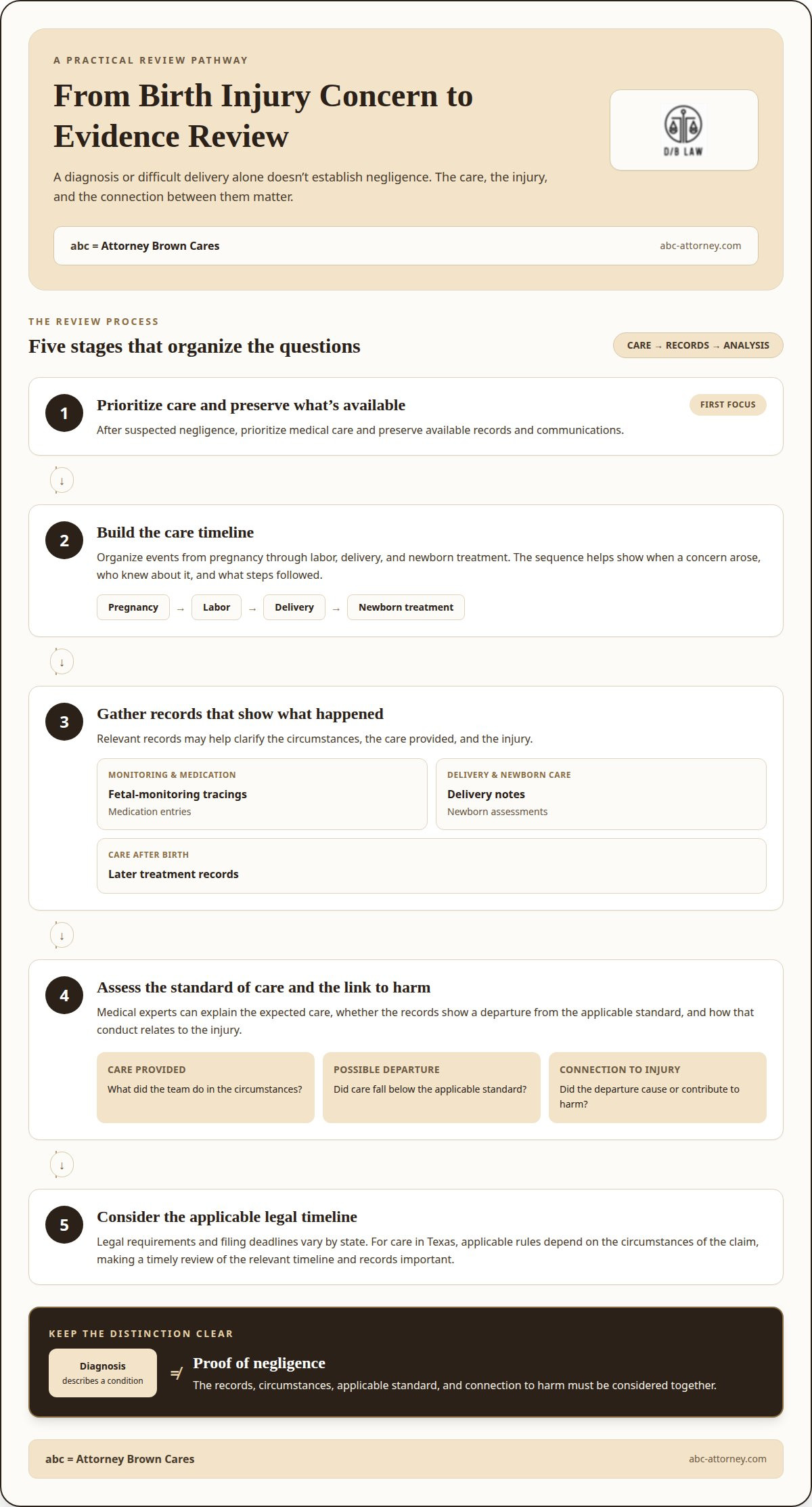
After suspected negligence, prioritize medical care and preserve available records and communications. A review can organize the timeline from pregnancy through labor, delivery, and newborn treatment, then assess whether a departure from the standard caused harm. Relevant records may include fetal-monitoring tracings, medication entries, delivery notes, newborn assessments, and later treatment records.
Medical experts can explain the expected care and whether the records show a deviation. Their analysis may also address how that conduct relates to the injury. A diagnosis alone doesn’t establish negligence.
Legal requirements and filing deadlines vary by state. For care in Texas, the applicable rules depend on the circumstances of the claim, so families need a timely review of the relevant timeline and records.
Birth injuries including cerebral palsy and hypoxic-ischemic encephalopathy
Birth injuries can affect a child’s movement, development, medical needs, or ability to manage daily activities. A diagnosis doesn’t by itself show that negligence caused the condition. The circumstances of pregnancy, delivery, and newborn care help explain what happened.
Cerebral palsy may be associated with serious brain injury. Hypoxic-ischemic encephalopathy, or HIE, is another serious neurological injury considered in birth injury cases. A medical review examines the child’s diagnosis alongside the timing of symptoms and the care provided. This helps distinguish the injury’s effects from evidence about how it occurred.
Other Birth Injury Conditions
HIE and kernicterus are distinct conditions, and each requires attention to the child’s specific diagnosis and medical history. Records can clarify when concerns first appeared, what assessments followed, and what treatment the newborn received. A condition’s name alone doesn’t identify its cause or show whether care fell below the applicable standard.
Other injuries associated with delivery complications include brachial plexus injury, facial nerve injury, and trauma involving shoulder dystocia. The affected area, examination findings, and later specialist assessments help describe the injury and identify questions for a medical review.
Physical and Cognitive Effects
Birth injuries may lead to physical disabilities, developmental delays, chronic medical conditions, or long-term care needs. Cerebral palsy can affect movement, while some injuries may also affect cognitive development. A child’s needs depend on the condition, its severity, when it was recognized and treated, and the child’s individual circumstances.
Families may need to understand how an injury affects mobility, communication, learning, and daily care. Depending on the injury, treatment may involve medical support, specialist care, therapy, rehabilitation, or assistive devices. Needs may change as a child develops, making ongoing assessments important.
Alleged Birth Malpractice Examples
Allegations may involve failing to prepare for a known birth risk, delayed recognition of a newborn’s breathing problem, or an error during immediate resuscitation. An intubation concern, for example, may involve an incorrectly placed tube or a failure to confirm it is working. These examples show why records and the sequence of care matter.
For Texas families, a careful review focuses on the care provided, the injury, and the evidence connecting them. Medical experts can assess whether providers departed from the applicable standard and explain how that departure may have caused harm. The child’s diagnosis and later care needs help describe the impact, but neither proves negligence on its own.
Failure to monitor fetal heart rate and oxygen
Monitoring helps the delivery team detect changes in the baby’s condition and the mother’s health. A missed warning or delayed response can allow distress to worsen.
Fetal heart rate can be assessed by listening, known as auscultation, or through internal or external electronic monitoring. Maternal vital signs also matter during labor. A change in the mother’s condition alongside an abnormal fetal heart rate, for example, may require attention. Records can show what staff observed and how they responded.
Fetal and Maternal Monitoring Failures
Monitoring failures occur when staff don’t adequately track or respond to changes in the mother or baby. A review follows what the monitoring showed, when staff saw it, and what action came next. Missed or delayed responses to changing vital signs, for example, may raise questions about whether the team addressed a developing risk.
Communication determines how information reaches the person making care decisions. Fetal-monitoring entries, a nurse’s notes, and a doctor’s response can help establish whether a warning was communicated and acted on.
Fetal Heart-Rate Monitoring
A fetal heart-rate tracing can show a rate that is too fast, too slow, or irregular. Such findings call for prompt investigation and treatment. Because Pitocin-induced contractions can disrupt a baby’s heart rate and oxygen level, medication timing, monitoring, and staff response are relevant.
Records may reveal monitoring gaps or a failure to respond to a concerning pattern. A tracing alone doesn’t establish negligence; timing and context matter. The review considers what the team knew and whether its subsequent actions addressed the baby’s condition.
Delayed Cesareans During Fetal Distress
A delayed C-section may raise concern when signs of fetal distress persist and the team doesn’t act in time. For example, a significant drop in a baby’s heartbeat followed by a delayed emergency C-section has been described in cases involving cerebral palsy. The central issue is whether the delay departed from accepted care and contributed to injury.
Records can reconstruct when distress appeared, when clinicians recognized it, and when delivery occurred. A Texas case involving oxygen deprivation resulted in an award of over $5.97 million. That case illustrates the serious consequences alleged in delayed-response claims, but an award doesn’t determine the value of another family’s case.
For a suspected monitoring failure, relevant evidence includes fetal tracings, maternal vital-sign records, medication entries, staff notes, and delivery timing. Together, these materials can clarify whether a warning was missed, a response delayed, and the delay caused harm during childbirth. A serious outcome deserves careful review, but the injury itself doesn’t prove a preventable error.
Can you sue a hospital for traumatic birth?
A hospital may be sued when evidence connects preventable care errors by responsible providers to harm during childbirth. Pitocin, forceps, and vacuum extractors are examples of interventions that may require close attention.
Misuse of Labor Medications
Pitocin misuse may include giving it unnecessarily, using an excessive dose, or failing to stop it when maternal or fetal distress occurs. These errors matter because Pitocin-induced contractions can disrupt a baby’s heart rate and oxygen level. A review considers why the medication was given, how it was administered, and whether staff responded to changes.
Records may show when Pitocin was started, whether contractions or fetal heart-rate changes followed, and when staff adjusted or stopped the medication. These details help assess whether the response met the standard of care and whether an error caused injury.
Improper Forceps Use
Improper forceps use means handling or applying the instrument in a way that may injure the baby or birthing parent. Forceps-related harm may include injury to a baby’s face, brain, or nerves, or damage around the parent’s reproductive organs. Delivery notes and injury findings help explain how the tool was used and what harm followed.
Forceps use alone doesn’t establish negligence. The circumstances of pregnancy and delivery matter, including the reason for assisted delivery, the technique used, and whether the response to complications was appropriate. Those details can help a birth injury attorney assess whether care fell below the accepted standard.
Vacuum-Assisted Delivery Errors
Vacuum-assisted delivery errors involve improper use or handling of the extractor during childbirth. Misuse may cause skull fractures, nerve damage, or facial paralysis. The newborn’s immediate condition, the delivery record, and later examinations can help connect a specific injury with the extraction.
A careful review examines why the vacuum was used, how the delivery unfolded, and what staff did when complications arose. If an extraction attempt didn’t resolve the problem, the timing and decisions that followed may also matter. The question is whether an error caused harm, not simply whether a vacuum extractor was used.
A traumatic birth doesn’t automatically make a hospital liable. A claim may involve providers responsible for preventable errors during labor, delivery, or immediate newborn care. The evidence must show a departure from the applicable standard of care and a connection between that failure and the injury. Medical records and expert review can help establish those facts.
Common labor and delivery complications
Complications can arise from conditions present during pregnancy or changes during labor. Gestational diabetes, preeclampsia, and infections can increase delivery risks, but their presence alone doesn’t establish medical negligence. The important questions are how the care team identified each risk, what decisions followed, and whether a preventable error caused harm. A clear timeline can connect pregnancy history with labor events, the baby’s condition, and treatment after birth.
Gestational diabetes, high blood pressure associated with preeclampsia, and infection are distinct concerns, but each can affect delivery planning. Medical records may show whether a condition was recognized, how it changed over time, and what steps staff took in response. A review can compare documented risk factors with decisions made during labor, and examine whether changes in the mother’s or baby’s condition prompted reassessment or a change in treatment.
A breech position is another delivery complication. Babies in breech position are normally delivered by cesarean section for their safety. The relevant review considers when the position was identified, how the delivery plan addressed it, and what happened as labor progressed. A C-section decision should be understood in the context of the pregnancy and the events at delivery, rather than judged only by the outcome. Records can clarify the sequence of decisions and care.
Complications may also develop as labor unfolds. Fetal distress, difficulty progressing through delivery, or a sudden change in the mother’s condition can require the team to reassess. The care timeline matters: what signs appeared, when staff recognized them, and what action followed. Medical negligence may be a concern if a preventable failure to respond caused injury, but a complication or unexpected outcome alone doesn’t establish that connection.
For a focused review, organize pregnancy records, labor notes, delivery records, and newborn treatment information into one timeline. Compare documented risks, changes in condition, decisions, and outcomes. If a baby experienced oxygen deprivation, for example, the review can examine the events leading to the injury and the response afterward. This approach helps distinguish an unavoidable complication from a preventable error and clarify what evidence may support a claim.
If a birth injury followed pregnancy or delivery complications, discuss your birth injury concerns with a legal team that handles medical malpractice litigation.
The Dedric Brown Law Firm
The Dedric Brown Law Firm represents families facing suspected negligence and birth injuries. When questions remain about whether a provider’s actions caused harm, the firm can assess the medical timeline, records, and evidence connecting care to the injury. This review helps families understand whether a medical malpractice claim may be appropriate.
The firm handles birth injury and medical malpractice litigation, including cases involving traumatic brain injuries and hypoxic or anoxic brain injury. Its approach reflects abc, meaning Attorney Brown Cares, with personal attention to each family’s concerns and the child’s needs. Families can turn to the firm for legal guidance in evaluating a possible claim.
Contact The Dedric Brown Law Firm to discuss your concerns about a birth injury.
Take the Next Step Toward Clarity
Deciding what to do after a birth injury can feel overwhelming, especially when the medical timeline is difficult to piece together. You don’t have to reach a conclusion alone. A focused legal review can help clarify whether labor and delivery malpractice may have contributed to the harm and which questions deserve closer attention.
The Dedric Brown Law Firm approaches these cases with care for the family and close attention to the evidence. Sharing your concerns is a practical first step toward understanding your options. You don’t need to have every answer before starting a conversation.
Contact The Dedric Brown Law Firm to discuss your concerns and take a thoughtful next step. Your family deserves clear answers and support as you move forward.
Frequently Asked Questions
What Is Medical Malpractice?
Medical malpractice is a claim that a healthcare provider’s care fell below the accepted professional standard and caused harm. For example, a claim might allege that a provider gave the wrong medication dose and that the error led to an injury. A poor outcome alone isn’t enough. The evidence must connect the provider’s conduct to actual harm, such as additional treatment, lasting impairment, or financial loss.
Can you sue if your child has cerebral palsy?
A family may be able to bring a claim if evidence shows negligent care caused or contributed to the child’s cerebral palsy. The diagnosis alone doesn’t establish the cause. A review may compare pregnancy records, delivery notes, newborn assessments, and later specialist findings to understand when the injury arose. Medical experts can assess whether care departed from the applicable standard and explain the connection to the child’s condition.
How do medical negligence during childbirth cases work?
A childbirth negligence case typically begins by gathering relevant records and assessing whether expert review supports a claim. It then proceeds through the applicable legal process, which may include presenting the claim, negotiations, or trial. State rules differ, so the place of care matters. For a Texas birth, records from Houston, San Antonio, Dallas, Austin, Beaumont, Huntsville, Prairie View, or Brenham can help establish where the care occurred.
How much are birth injury claims worth?
There’s no single amount that applies to every birth injury claim. Potential compensation depends on the harm and its documented effects, including medical care already received, future treatment needs, lost wages, and pain and suffering. A child who needs ongoing support may have different needs from one whose injury resolves with limited treatment. Care plans, specialist opinions, and evidence of daily assistance help describe the losses involved.
What Is Birth Care Malpractice?
Birth care malpractice refers to alleged substandard medical care during pregnancy, labor, delivery, or immediate newborn care that causes injury to a baby or birthing parent. The professionals involved may include doctors, nurses, or anesthetists. An allegation might concern a provider’s failure to recognize a serious complication or an error in medication administration. The claim depends on evidence about the care, the injury, and their connection.
What are delivery room errors?
Delivery room errors are mistakes in care during labor, birth, or immediate newborn treatment. They may involve preparation, communication, recognizing distress, or supporting a newborn’s breathing. An intubation error, for example, may involve selecting the wrong tube size, placing the tube incorrectly, or failing to confirm it works. These events need to be reviewed in context, including what the team knew and how it responded.
What counts as labor and delivery malpractice?
Conduct may count as malpractice when a provider’s departure from the accepted standard causes injury. Examples include failing to diagnose arrested labor progress, delaying a needed cesarean, or giving medication incorrectly. The circumstances matter: the risks known to the team, the options available, and the response to changing conditions. A claim needs evidence of both a professional breach and resulting harm, not simply a difficult or unexpected birth.
What are common examples of labor and delivery negligence?
Examples include failing to diagnose arrest of dilation or descent, not responding appropriately to fetal distress, and improperly administering labor medication. A claim may also concern failing to explain significant procedural risks. Records might show, for example, that medication was given despite warning signs or that a complication went unrecognized. Each allegation depends on the circumstances and whether the conduct caused harm to the baby or birthing parent.



Comments