
Negligent Security Attorney: A Texas Guide After an Injury

Could inadequate security have helped make a criminal attack possible, even though someone else committed it? After an injury, that question can feel difficult and unfair. A negligent security attorney can examine whether preventable security risks at a Texas property may have contributed. Responsibility depends on the facts, including what the property owner knew or should have known.
You may also worry that surveillance footage, incident reports, or other records could disappear before anyone reviews them. This guide explains what negligent security generally means in Texas, how foreseeability and other facts can shape a claim, what evidence may matter, and practical steps to consider after an injury. You don’t have to sort through every unanswered question alone.
The Dedric Brown Law Firm represents people in negligent security matters. ABC means “Attorney Brown Cares,” a commitment to personal attention and careful consideration of the evidence and potential next steps. The firm’s mission is “Fighting for your rights with integrity and dedication.” A free case review gives you a chance to discuss what happened and consider a path forward, with support from consultation through courtroom.
Table of Contents
What Is a Negligent Security Claim in Texas, and When Might It Apply?
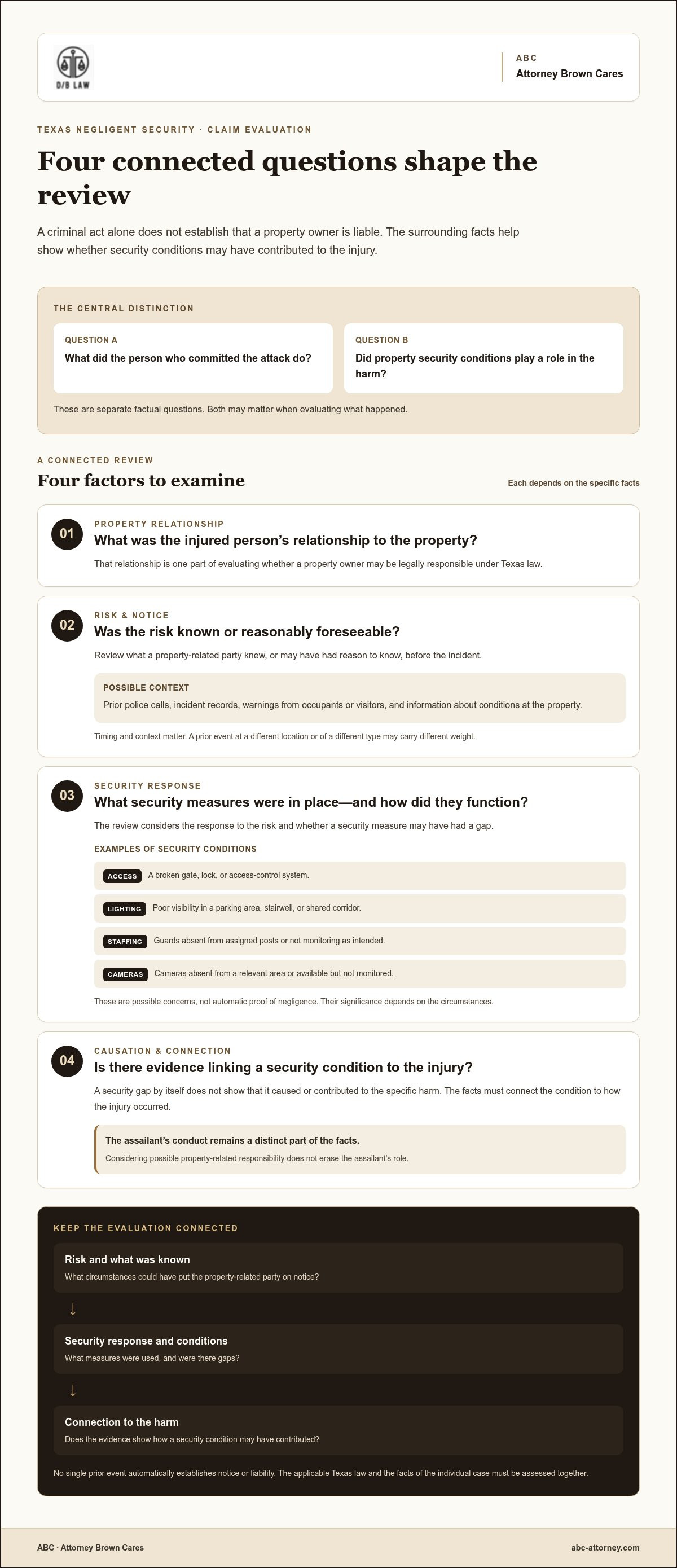
An injury claim may arise when inadequate security at a property contributed to someone being harmed by a criminal act. The claim focuses on whether conditions or security measures at the property played a role, not only on the actions of the person who committed the attack. These are separate factual questions, and both may matter when evaluating what happened.
Negligent security is generally considered a type of premises liability claim, a broader area involving injuries connected to property conditions. In Texas, whether a property owner may be legally responsible depends on the injured person’s relationship to the property, the circumstances surrounding the risk, and the security response. A criminal incident by itself doesn’t establish that the owner is liable. The specific facts and current Texas law must be assessed together.
For example, someone injured in a poorly lit parking area might question whether better lighting could have affected the circumstances. That question alone doesn’t establish whether a claim applies. A negligent security attorney can assess the security conditions alongside what was known about the risk and how the injury occurred.
What security failures may lead to a claim?
Potential security concerns are easier to assess when tied to a specific location and the function of the security measure. Examples may include:
Access control: A broken gate, lock, or access-control system at an apartment entryway may allow unauthorized access.
Lighting: Poor lighting in a parking area, stairwell, or shared corridor may limit visibility in a place where people need to see and move safely.
Staffing: A property may lack security guards, or guards may leave assigned posts or sleep while on duty, leaving an area without the intended monitoring.
Surveillance: Cameras may be absent from a relevant area, or available cameras may not be monitored. Their presence alone doesn’t establish that a risk was addressed.
These examples describe possible issues, not automatic proof of negligence. Their significance depends on the circumstances, including the property’s use, the nature of the risk, and whether a different security response may have mattered.
Where can negligent security incidents happen?
Incidents may occur in apartment buildings, businesses, parking areas, entryways, or shared corridors. The type of property doesn’t decide whether a claim is viable. Relevant questions include who controlled or managed the area, what security measures were in place, and whether the conditions may have contributed to the injury. A crime on private property doesn’t, by itself, establish that the owner failed to act reasonably or is legally responsible.
That distinction keeps the inquiry focused. The goal is not to assume blame because a harmful event occurred, but to examine the security conditions and surrounding facts carefully. Identifying the specific location and security concern can help frame a more informed review, even when the answers aren’t immediately clear.
How Texas Negligent Security Claims Are Evaluated: Risk, Notice, and Causation
Texas negligent security claims turn on more than the fact that a crime occurred. A review connects four questions: What was the injured person’s relationship to the property? Was the risk known or reasonably foreseeable under the circumstances? What security response was taken? And is there evidence linking a security failure to the injury? The precise legal test depends on current Texas law and the facts of the individual case.
These questions also distinguish between different kinds of proof. Evidence that a security measure was inadequate may show a potential problem, but it doesn’t automatically show that the problem caused or contributed to the injury. The claim must be assessed as a connected sequence, from the risk and the property’s response to how the harm occurred.
Why risk and notice matter
Risk and notice concern what a property-related party knew, or may have had reason to know, before the incident. Relevant facts could include prior police calls, incident records, warnings from occupants or visitors, and information about conditions at the property. No single prior event automatically establishes notice or liability. A case also shouldn’t be reduced to whether an earlier crime was identical. The significance of any history depends on its details and the applicable Texas law.
Timing and context matter. A report involving a different location or type of incident may carry different weight than a warning about the same area or a continuing security concern. A negligent security attorney can examine available records and circumstances to assess how they may bear on foreseeability and the property’s response.
How causation and responsibility are considered
The causation question is whether a security condition contributed to the harm, not simply whether the condition existed. For example, records might identify a gap in a security measure, while other evidence may be needed to explain whether that gap had a meaningful connection to the specific incident. The assailant’s conduct remains a distinct part of the facts. Evaluating possible property-related responsibility doesn’t erase the assailant’s role.
Responsibility can also depend on who controlled the relevant area and who had a role in providing or managing security. An owner, property manager, or security provider might be examined, but their involvement alone doesn’t establish legal responsibility. The evidence and current Texas law must support any conclusion about a party’s duties, actions, and connection to the injury.
A careful review looks for links between notice, the security response, and the way the injury occurred. If you’re unsure how those facts fit together, you can discuss your negligent security concerns and potential next steps with the firm.
What Evidence Can Help Explain a Texas Negligent Security Incident?
Evidence can help organize what happened: what the area was like, how the incident unfolded, and what injuries followed. No single record necessarily answers every question. A negligent security attorney can compare different sources, identify where details align, and note what remains unclear.
Prompt, accurate documentation can preserve details that are easy to forget and help make a later review more complete.
Evidence category
Questions it may help answer
Incident reports and paperwork
What was reported, when, and to whom? Do the records describe the location or security concern?
Photographs
What could the area, lighting, entrance, lock, or other visible condition show at the time the photos were taken?
Medical records
What injuries were documented and what care was provided? These records may help explain the effects of the incident.
Witness details
Who saw the incident or conditions before or afterward, and how can they be contacted?
Available video or access records
Could footage or entry records clarify timing, movement, or who accessed an area?
Maintenance or staffing records
Could records shed light on a reported condition, repair, security assignment, or response?
Document the incident, conditions, and injuries
As soon as you can, write down the location and your best recollection of the sequence of events. Note details such as the lighting, nearby entrances, and visible security conditions. Keep copies of incident paperwork and relevant messages, along with contact information for people who witnessed events. Memories can change with time, so distinguish what you personally observed from what someone else told you.
Keep medical records and other paperwork related to your care. Follow the guidance of your treating professionals. You don’t need to decide what a document proves before preserving it. A clear record can help someone assess the facts later, particularly if evaluating the long-term impact of severe physical injuries requires life care planning from Injury Consulting LLC.
Connect records to the security questions
Footage, if available, may show conditions or timing, but its coverage and availability vary. Maintenance records may relate to a reported broken fixture, while staffing or access records may help clarify assignments or entry activity. Such records may be held by different people or organizations, including a property manager, security provider, or another entity. Their contents and significance need to be assessed in context.
Keep original files when possible, note where each item came from, and avoid editing photos or messages. An organized timeline can help connect reports, witness observations, and medical documentation without treating any one piece as conclusive. Preserve what you have and record what you know. A careful review can then identify which facts support the next questions.
Steps After a Negligent Security Injury in Texas
A traumatic incident can leave you with urgent concerns and unanswered questions. Start with what matters most: your safety and health. Then take manageable steps to record what you remember and keep important information together. You don’t need to determine fault or resolve every detail on your own.
Take care of immediate needs and preserve basic records
Move to safety and seek appropriate medical care. If you’re in immediate danger, focus on getting to a safer place and contacting emergency services as appropriate. Attend to injuries and follow the guidance of your treating professionals. Your well-being comes first.
Write down what you recall. When you’re able, note where and when the incident happened and the sequence of events as you remember them. Include details about the area and any security conditions you personally observed. If you’re uncertain about a detail, say so rather than guessing. Separate what you saw from what you inferred or heard from someone else.
Keep related records together. Save photographs, incident paperwork, relevant messages, and contact details for witnesses in one place. Keep copies of records related to medical care and any communication with the property or its representatives. Preserve original files when possible, and avoid changing or annotating the only copy of a photo or message.
Accurate notes don’t have to be lengthy. A brief timeline can help you recall what happened without filling gaps with assumptions. If you later learn that a detail was mistaken, update your notes clearly rather than silently changing the original account.
Get legal guidance before key decisions
Ask questions before making important decisions about a claim. Statements, forms, or requests for information may raise issues that depend on the circumstances. Read documents carefully, keep copies of what you receive or send, and avoid speculating about disputed facts. Explain honestly what you know and what you don’t know.
Seek a timely review of the facts. Legal deadlines and other issues depend on the specific circumstances and current Texas law. Don’t assume that a general rule answers your situation. A negligent security attorney can review what happened, consider available information, and discuss potential next steps.
You don’t need a complete file before asking questions. A free case review with The Dedric Brown Law Firm gives you an opportunity to discuss the incident and possible next steps. Request a free case review when you’re ready to talk through your concerns.
How Attorney Brown Cares for Texans Considering a Negligent Security Claim
After a frightening incident, legal questions can feel like one more burden. Attorney Brown’s approach centers on listening to your concerns, understanding what you’ve experienced, and helping you consider next steps. ABC means “Attorney Brown Cares,” and the firm’s mission reflects that commitment: “Fighting for your rights with integrity and dedication.”
A negligent security attorney should help you understand the issues without assuming the outcome. A review may consider the information you have, the questions that remain, and how Texas law may apply to your circumstances. You can ask questions and discuss your concerns without arriving with a complete file or legal conclusion.
What a client-centered case review can offer
The firm’s free case review is an opportunity to discuss the incident and potential legal questions. You can explain what happened, share available information, and talk through possible next steps. The firm provides personalized representation and support from consultation through courtroom. What that support involves depends on the matter. A review doesn’t promise case acceptance, a particular strategy, a settlement, or a result.
The conversation can also help bring immediate questions into focus. You might want to understand how records could be evaluated, what facts may still need clarification, or which legal issues deserve attention. The goal is a thoughtful discussion, not pressure to make a decision before you’re ready. Share what you know and be candid about what you’re unsure of.
A transparent way to discuss representation
The firm states: “You Pay Nothing Unless I Win Your Case!” This is the firm’s stated contingency-fee model, not a promise that a particular case will succeed. During a case review, you can discuss your situation and ask questions about the representation being considered.
Care also means treating your experience with respect while examining the facts carefully. Whether your concerns involve the events, the property’s security, or what to do next, you deserve a clear conversation about the available information. You don’t need to have every answer before reaching out.
If you’re ready to talk, Contact the firm for a free case review. Attorney Brown and the firm can hear your concerns and discuss potential next steps with you.
Take the Next Step With a Clearer Path Forward
You don’t have to decide on your own whether a property owner may be responsible. A conversation with a negligent security attorney can help you consider what your experience and available information may mean under Texas law. It can also help identify questions to address before making important decisions about a potential claim.
If you’re still uncertain, that’s understandable. You can start by explaining what happened in your own words and asking what the next steps might involve. You don’t need to have every detail settled before reaching out.
Contact the firm for a free case review to discuss your situation with Attorney Brown. One conversation can be a steady first step toward understanding your options and deciding how you want to move forward.
Frequently Asked Questions
Can I pursue a negligent security claim if the attacker was never identified or arrested?
Possibly. An arrest or criminal conviction and a civil injury claim are separate matters, and an unresolved investigation doesn’t automatically decide whether a civil claim can proceed. If the attacker hasn’t been identified, details such as the incident timeline, location, descriptions, and available records may still help explain what happened. Keep any information you receive from investigators, but don’t treat it as a final answer about a property-related claim.
Does a negligent security claim require a prior crime at the same property?
Not necessarily. A history of incidents may be relevant, but don’t assume that a particular kind of prior crime is always required or that one event settles the question. Warnings, conditions at the property, and details of the incident may also matter. For example, records of prior concerns about an entry point could be relevant even if they describe different events. A Texas attorney can assess the complete circumstances under current law.
Can a visitor bring a negligent security claim if they do not live at the property?
A visitor may be able to ask whether a security failure contributed to an injury. Living at the property isn’t the only fact that may matter. The reason for the visit, where the incident occurred, and the circumstances of entry can affect the analysis under Texas law. Keep items that show the purpose of your visit, such as an invitation, appointment confirmation, or messages arranging to meet someone there.
Should I speak with the property owner's insurance company after an incident?
You may receive a call, form, or request for a statement. Keep your answers accurate, and don’t guess if you can’t remember a detail. Save copies of communications and note when and how you received them. Before signing a document or responding to a request with important consequences, take time to understand what’s being asked and consider legal guidance based on your specific circumstances.
What if I may have contributed to the incident?
Your actions may be part of the facts, but they don’t automatically resolve whether a property-related security issue also contributed to the harm. Be straightforward with a negligent security attorney about what you remember, including details you think may be unfavorable. Avoid deciding for yourself that a claim has no merit. Responsibility and recovery can depend on current Texas law and the full circumstances, so get advice tailored to the incident.
How long do I have to bring a negligent security claim in Texas?
The deadline depends on current Texas law and the circumstances of the claim, so this FAQ can’t determine the filing period that applies to you. Don’t rely on a general online answer or wait until every document is gathered to ask about timing. A prompt, case-specific review can help identify deadline questions. This is relevant whether an incident occurred in Houston, San Antonio, Dallas, Austin, Beaumont, Huntsville, Prairie View, or Brenham.
Is a negligent security claim separate from a criminal case?
Yes. A criminal case concerns alleged criminal conduct, while a civil claim examines whether another party may have legal responsibility for an injury. Some records or events may be relevant to both, but a criminal case’s status doesn’t by itself determine whether a property-related claim is viable. Keep notices, correspondence, or other documents you receive about either matter, and get advice on how they relate to your specific situation.



Comments