
Traumatic Brain Injury Attorney for Survivors and Families

A serious brain injury can change a person’s life and reshape a family’s daily routine. A traumatic brain injury attorney investigates how the injury happened, examines evidence of responsibility and losses, and pursues a claim on the survivor’s behalf. This work requires careful attention to both the medical consequences and the facts of the incident.
It’s understandable to want clear answers before taking another step. This article explains what a TBI lawyer does, how a case is investigated and documented, and how contingency fees and litigation costs may work. You’ll also learn what to consider when choosing legal representation and how The Dedric Brown Law Firm’s focus on brain injury litigation connects to the needs of survivors and families. The firm stands for a commitment to personal attention as families face a difficult process.
Table of Contents
What Is a Traumatic Brain Injury Lawyer?
A traumatic brain injury lawyer investigates whether another party’s negligence caused the injury and pursues accountability. The work connects incident evidence, medical consequences, and financial losses into a supported claim.
Attorney Qualifications and Advocacy
Choose a lawyer whose work includes traumatic brain injury claims, not only general personal injury matters. A TBI can affect memory, communication, mood, and the ability to work. The attorney should understand how these effects can shape a client’s daily life and future needs. Ask how the lawyer evaluates both visible injuries and less obvious cognitive changes.
Ask about the lawyer’s role in investigating, negotiating, and taking injury cases to trial. Useful questions include: How have you handled cases involving brain injuries? Who will lead the investigation and communicate with my family? How do you assess long-term medical and financial effects? Clear answers help you understand the firm’s approach and who will advocate for you.
Review the proposed strategy, not just a title or time in practice. A traumatic brain injury attorney should explain how the legal team will connect the incident to the diagnosis and resulting losses. For example, the lawyer may compare incident records with treatment records and work history. That analysis can reveal gaps that need further investigation.
Evidence and Expert Collaboration
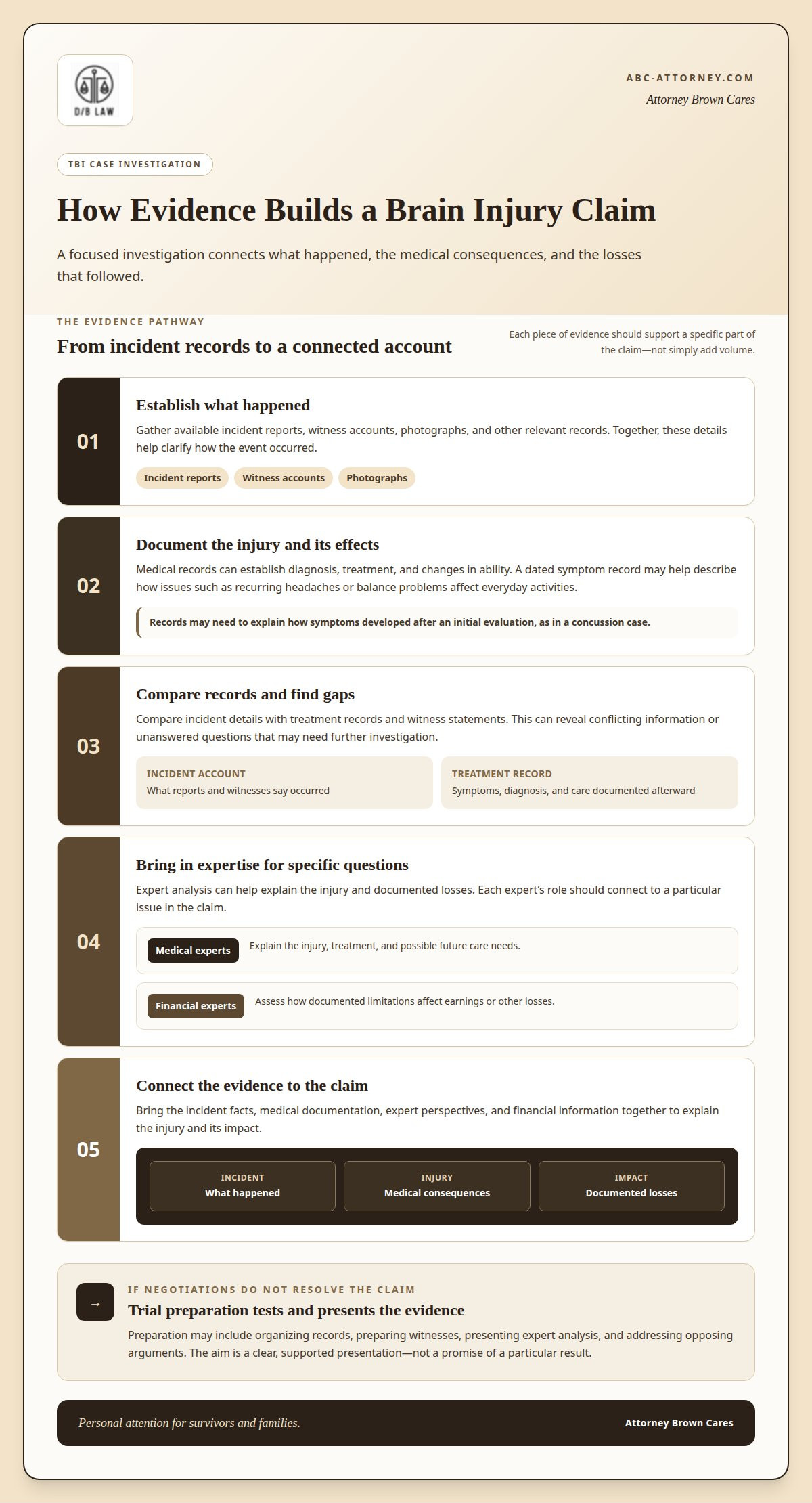
Evidence gathering starts with the incident. The attorney can seek available reports, witness accounts, photographs, and other records. Medical documentation can establish the diagnosis, treatment, and changes in ability. A dated symptom record, such as recurring headaches or balance problems, may help show how the injury affects everyday activities.
Medical experts can explain the injury, treatment, and possible future care needs. Financial experts can assess how documented limitations affect earnings or other losses. The attorney brings these perspectives together with the records and known facts. This collaboration helps present a connected account rather than a collection of unrelated documents.
Ask what evidence the legal team will gather, which experts may be useful, and how their analysis will support the claim. A focused answer should connect each expert’s role to a specific issue, such as diagnosis, future care, or financial impact. This makes the investigation easier to understand and evaluate.
A settlement or lawsuit has no single timeline; medical progress, evidence gathering, liability disputes, negotiations, and trial can affect its duration. Ask the attorney what steps remain, what could delay them, and how updates will be shared. Filing deadlines also vary by state; personal injury statutes of limitations typically range from one to six years.
Investigating and documenting a TBI case
A strong investigation connects how an incident happened to the brain injury and its consequences. At abc-attorney, Attorney Brown Cares, the legal team can give families personal attention while assembling incident records, witness accounts, available photographs, and medical documentation. In a concussion case, for example, the records may need to explain how symptoms developed after the initial evaluation. Each item should support a specific part of the claim, not simply add volume.
Next, the attorney can compare the evidence for gaps or conflicting details. A crash report may describe the collision, while treatment records document symptoms and care. Witness statements may clarify what happened before or after impact. Medical professionals can explain diagnosis and treatment, while financial experts can analyze documented effects on work and future needs. This coordinated analysis helps show the injury’s impact without treating every record as proof of every loss, while keeping the family’s needs in view.
Texas brain injury case results depend on the evidence in each claim. Relevant questions include whether records support negligence, how clearly the injury is documented, and what harm followed. A prior result cannot establish what another case will recover. A sound evaluation examines the specific incident, medical evidence, losses, and disputed facts before assessing how to pursue the claim, with care for the family’s circumstances.
Contingency fees and case costs are separate issues to understand before representation begins. The written agreement should explain how the attorney’s fee is calculated and what expenses may arise during investigation or litigation. Under some contingency arrangements, the client owes legal fees or case costs only if there is a recovery. The agreement controls the terms, including how costs are handled if the case does not recover compensation. Attorney Brown can take time to explain these terms and answer families’ questions.
If negotiations do not resolve a serious claim, the attorney may prepare to take it to trial. This can involve organizing records, preparing witnesses, and presenting expert analysis that connects the incident to the injury and losses. Trial preparation also tests weaknesses in the evidence and addresses opposing arguments. The goal is a clear, supported presentation, not a promise of a particular result. Throughout the process, Attorney Brown’s care-focused approach means families receive personal attention and clear communication.
A case evaluation can help identify the central issues: what happened, what records exist, and what questions remain. The discussion may also cover potential evidence, the investigation process, fee terms, and possible next steps. Families can bring relevant incident or treatment information when available, while the attorney explains what additional records may help. To discuss an injury claim with a legal team that puts care and personal attention first, contact an attorney about your case.
Contingency fees and litigation costs
Contingent-fee representation ties the attorney’s fee to a recovery rather than requiring hourly legal payments as work proceeds. In the arrangement described for brain injury cases, the client owes no legal fees or reimbursement of costs unless there is a recovery. This structure can help families pursue a claim after a severe injury without paying legal fees upfront. At abc-attorney, Attorney Brown Cares about helping clients understand these terms, and the written agreement explains how the arrangement applies.
Understand the fee agreement
Before signing, review how the fee is calculated and when it becomes due. Ask whether the calculation applies before or after case costs are deducted, and how any recovery will be distributed. These terms affect the amount the client receives. Attorney Brown will explain them with personal attention and care, in plain language, including what happens if negotiations fail and litigation becomes necessary.
Separate attorney fees from case costs. Fees pay for legal representation; costs cover expenses involved in developing and presenting the claim. Medical record collection, expert analysis, and deposition expenses can arise as the legal team builds its case. The agreement should explain which costs may be advanced, how they are tracked, and whether reimbursement comes from a recovery. Attorney Brown will take time to explain these details so clients can consider them with confidence.
How case costs are handled
Experienced brain injury law firms may advance substantial investigation and litigation costs. Under the arrangement described, they do not seek reimbursement if there is no recovery. Ask for a clear explanation of this provision before representation begins. Attorney Brown will personally review the terms with you, including how the agreement treats expert expenses if a case proceeds toward trial but produces no recovery.
A careful review distinguishes the attorney’s fee from costs deducted from a settlement or award. Ask the attorney to explain each deduction clearly, using hypothetical figures only if they can be applied accurately. Attorney Brown is committed to giving each client personal attention so they can understand how the written terms would apply if compensation is obtained, without treating the discussion as a prediction of the result.
When someone has suffered a traumatic brain injury, financial pressure can complicate decisions about legal representation. A contingency arrangement may make it possible to pursue a claim without paying attorney fees as the case progresses. It does not mean every expense is handled the same way. The fee agreement controls the details, and abc-attorney, Attorney Brown Cares, will help families understand its terms before signing.
Ask the attorney to explain three points: how the fee is calculated, which costs may be advanced, and what happens if there is no recovery. Attorney Brown will answer with care and personal attention, helping clients weigh the financial terms alongside the proposed legal strategy. Someone harmed through another party’s negligence deserves to understand the commitment before authorizing a law firm to represent them.
Specialized representation for traumatic brain injury survivors
Specialized personal injury representation considers how a brain injury affects a person, not only how the incident happened. A survivor may face headaches, balance problems, memory changes, or shifts in mood. These effects can influence communication, daily routines, and work. At abc-attorney, “abc” means “Attorney Brown Cares,” and that commitment to personal attention guides a careful legal strategy that connects these changes to medical records and the specific losses claimed.
During a consultation, the attorney should learn how the injury changed the survivor’s circumstances. For example, a family may describe new difficulty following conversations or managing familiar tasks. The legal team can compare those observations with treatment records and the timeline of symptoms. This compassionate approach keeps the person’s experience central, rather than reducing the claim to a diagnosis or a single medical visit.
Brain injury cases can involve distinct care needs. Treatment may include surgery, intensive care, medication, assistive devices, counseling, rehabilitation, or ongoing care. The attorney’s analysis should distinguish treatment already received from future needs supported by medical information. If the survivor needs help with ordinary activities, the claim should explain how this affects daily life and the support the family provides.
Families also need a clear role in decisions and communication. When a severe TBI leaves someone unable to communicate or make legal decisions when a claim needs to be filed, a family member may need to be appointed guardian, or an existing power of attorney may allow someone to pursue the claim. In keeping with Attorney Brown Cares, the attorney can provide personal guidance on who is positioned to act and what information is needed to evaluate representation.
A settlement discussion should reflect the injury’s documented impact, not pressure to resolve a personal injury claim quickly. The legal team can weigh medical information, current limitations, future care needs, and financial losses before assessing an offer. For instance, an offer addressing immediate treatment alone may not account for ongoing rehabilitation or lasting changes in ability. The outcome depends on the evidence and disputed issues.
Specialized advocacy also means presenting the survivor as a whole person. Records and expert analysis can establish medical facts, while family statements may explain practical changes at home. With Attorney Brown Cares’ commitment to listening and personal attention, the attorney can organize these perspectives into a consistent account of the incident, the injury, and its consequences. This focused presentation helps decision-makers understand what victims and families want them to consider.
When a survivor has a hypoxic or anoxic brain injury, the legal analysis must focus on the circumstances and evidence specific to that injury. The same principle applies across brain injury claims: identify the key questions, connect them to reliable records, and explain how the injury changed the person’s life. Specialized representation keeps that human impact visible throughout the claim.
How is liability proven in a traumatic brain injury case?
Proving liability means building a supported account of what happened, who may be responsible, and how the incident caused the brain injury. Attorney Brown carefully examines the conduct involved and connects it to reliable evidence, because abc means “Attorney Brown Cares.” For example, a traffic collision claim may require analysis of crash records, witness accounts, and medical documentation. Each part must fit the same timeline.
The investigation starts by identifying the incident’s setting and possible sources of proof. In a vehicle crash, Attorney Brown may examine available reports, photographs, and statements from people who witnessed the collision. In a fall, the review may focus on the location, maintenance records, and accounts describing the conditions. These details help clarify whether another party’s conduct contributed to the event.
Next, the evidence must connect the event to the diagnosed injury. Medical records can document symptoms, examinations, and treatment after the incident. Attorney Brown compares those records with the reported timeline and circumstances of the injury, with care for how the evidence reflects the client’s experience. If symptoms or treatment changed over time, the sequence matters. Medical analysis can help explain whether the injury is consistent with the event being investigated.
Responsibility may be disputed. A defendant might offer a different account of how the incident happened or challenge whether it caused the injury. Attorney Brown assesses those arguments against available records and witness evidence, keeping the client’s well-being in view. For instance, conflicting descriptions of a collision may make independent accounts and physical evidence especially important. A claim should address weaknesses directly rather than ignore them.
Evidence of the injury alone does not establish who caused the incident. The investigation must also examine the actions and conditions surrounding it. That may mean comparing timelines, locating inconsistencies, and determining what additional records could clarify disputed facts. Attorney Brown then organizes the proof into a coherent explanation of the incident, the alleged responsible conduct, and the connection to the injury, with personal attention to the client’s concerns.
Finally, the claim must document the harm linked to the incident. Treatment records, information about daily limitations, and evidence of financial losses can help explain the injury’s consequences. If a survivor needs ongoing care or can no longer perform familiar tasks, those effects should be supported by relevant documentation. Attorney Brown understands that these details matter to a client’s life and takes care to distinguish established facts from unresolved questions, giving each claimed loss a clear evidentiary basis.
Liability analysis is specific to the event and evidence, not just the severity of the injury. Attorney Brown’s focused, caring legal review can identify the strongest proof, the gaps requiring investigation, and the disputes that may shape negotiations or trial. Discuss the evidence in your brain injury case to understand the next step.
The Dedric Brown Law Firm: Traumatic Brain Injuries
The Dedric Brown Law Firm represents people and families facing traumatic brain injury claims. Its work also includes hypoxic and anoxic brain injury, birth injuries, and truck wreck cases. Consider turning to the firm when an injury raises questions about responsibility, medical impact, or losses that need careful legal analysis.
For survivors and families, legal representation should account for the person behind the medical records. The firm’s approach reflects abc, meaning “Attorney Brown Cares,” with a focus on personal attention throughout the legal process. A conversation can help clarify how the injury occurred, what evidence may matter, and whether a claim fits the firm’s work.
Contact The Dedric Brown Law Firm for a free case review and to discuss your situation.
Move forward with a plan that centers the survivor
Choosing a traumatic brain injury attorney is also a decision about how your family will be heard throughout a demanding legal process. A focused conversation can clarify your priorities, unanswered questions, and possible next steps. At abc-attorney, abc stands for “Attorney Brown Cares,” a commitment to listening and supporting your family. You can explain what matters most to the injured person, whether that means preserving independence, supporting care needs, or addressing changes in family responsibilities.
Before authorizing representation, consider what you need to understand: who will communicate with your family, how key decisions will be discussed, and how the legal strategy will account for the survivor’s goals. Clear expectations can help families take part while keeping the injured person’s dignity and voice at the center. The conversation should leave you better equipped to decide what comes next.
Every family’s circumstances are different, so let the survivor’s needs guide that discussion. Begin a conversation with The Dedric Brown Law Firm about your situation. A thoughtful next step can help make a difficult process feel more manageable.
Frequently Asked Questions
Can symptoms appear days later?
Yes, symptoms may become noticeable after the incident rather than immediately. After a concussion, symptoms can persist or worsen 60 or 90 days after the event. A change in behavior or conduct after a serious injury also deserves medical attention. If symptoms appear or change, seek an examination from a physician knowledgeable about brain injuries and describe when the changes began. At abc-attorney, “abc” stands for “Attorney Brown Cares,” and we’re here to help you find answers with personal attention.
If I had only a slight concussion, should I still talk to a lawyer?
It may be useful to speak with an attorney if another person’s negligence caused the incident or your symptoms affect daily life. A concussion label alone doesn’t show the full effect of an injury. For example, persistent headaches or difficulty concentrating may affect work or routine responsibilities. A legal discussion can help assess whether evidence supports a claim, while a medical professional evaluates symptoms and care needs.
What Are the Signs and Symptoms of TBI?
Possible signs include loss of consciousness, nausea or vomiting, prolonged headaches, vision problems, and difficulty with balance. Cognitive problems and mood changes can also occur. Symptoms vary, and a person may not show every sign. For example, a family member might notice a change in behavior or concentration after an incident. A physician knowledgeable about brain injuries can assess those changes.
What Compensation Can I Get If I’ve Suffered a Brain Injury?
Potential compensation depends on the losses supported by the evidence and the circumstances of the claim. Relevant losses may include medical treatment, rehabilitation, ongoing care, and financial effects such as reduced ability to work. For example, records showing continued treatment and work limitations can help document the injury’s impact. A claim evaluation considers what the evidence can establish, rather than assuming every loss will be covered.
What does a traumatic brain injury attorney do?
A traumatic brain injury attorney investigates how the injury occurred, identifies potentially responsible parties, and develops evidence connecting the incident to the harm. The attorney can review records, consult medical and financial experts, assess losses, and pursue a settlement. If negotiations don’t resolve the claim, the attorney may prepare it for trial. The legal work should account for how the injury affects the survivor’s circumstances.
When should I hire a brain injury lawyer after an accident?
Consider speaking with a lawyer early, particularly when another party may be responsible. Early legal review can help identify evidence to preserve and clarify which records matter. Filing deadlines vary by state, so timing can affect the ability to pursue a claim. If the survivor cannot make legal decisions, a family member may need guidance about who can act for them.
How do I find a qualified traumatic brain injury attorney near me?
Look for an attorney with experience handling brain injury claims and ask who will manage the investigation, explain case developments, and communicate with your family. The Dedric Brown Law Firm handles traumatic brain injury litigation in Texas, including matters for people in Houston, San Antonio, Dallas, Austin, Beaumont, Huntsville, Prairie View, and Brenham. A focused discussion can help you understand the firm’s approach to your circumstances.
What evidence is needed for a traumatic brain injury claim?
Evidence may include incident reports, witness accounts, photographs, medical records, and documentation of how the injury affects daily activities or work. The relevant mix depends on the event. For a vehicle collision, available crash records and witness statements may clarify what happened; treatment records may document symptoms and care. An attorney can identify which materials help establish responsibility, injury, and resulting losses.



Comments