
What Maximum Medical Improvement Means in New York Workers’ Comp

Maximum medical improvement doesn’t necessarily mean you’re fully healed. In Texas workers’ compensation, it means further improvement isn’t expected, or you’ve recovered as much as medically possible. If you haven’t reached MMI sooner, Texas law sets MMI by operation of law 104 weeks after the first day of disability.
It’s understandable to worry that an MMI finding could end treatment or limit your options. But reaching MMI doesn’t automatically mean your symptoms have disappeared. Understanding what maximum medical improvement means can help you make sense of the decisions ahead.
This article explains how MMI may affect ongoing care, settlement decisions, impairment ratings, and work restrictions in Texas. You’ll also learn why the 104-week timeline and your medical condition matter, and how The Dedric Brown Law Firm can guide you through the process.
Table of Contents
What If You Need Further Medical Treatment After You Reach Maximum Medical Improvement?
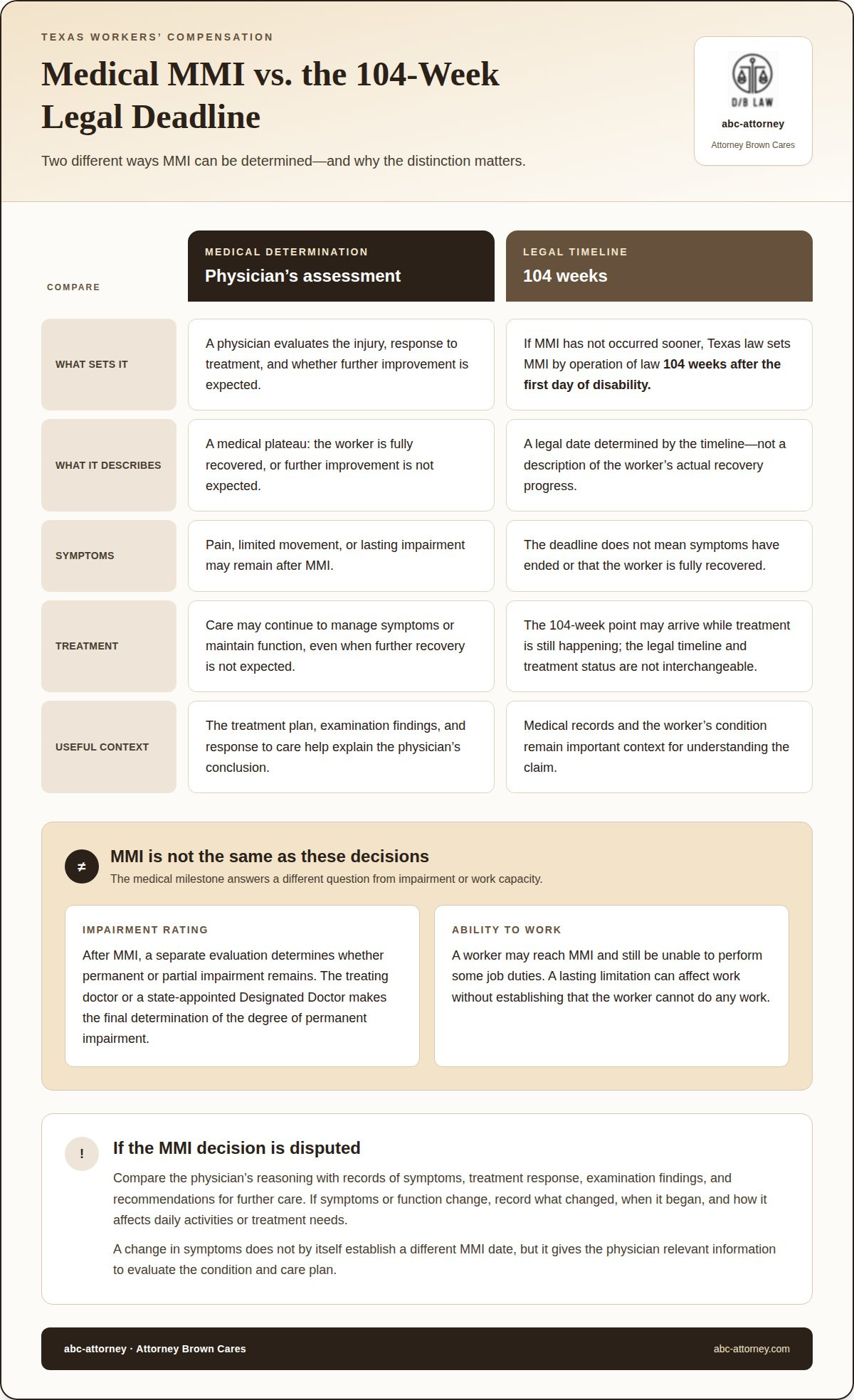
Reaching MMI doesn’t necessarily mean treatment stops or recovery is complete. In Texas, the 104-week legal MMI deadline and a doctor’s assessment are distinct considerations.
How does a doctor determine when someone has reached MMI? A physician evaluates the injury, the response to treatment, and whether further improvement is expected. Rehabilitation or symptom management may continue even after recovery reaches a plateau.
The Treating Physician’s Role
The treating physician assesses medical progress and whether additional treatment is expected to improve the worker’s condition. That matters because care may continue for reasons other than restoring function, such as managing symptoms or maintaining mobility.
For example, a worker may continue exercises to preserve movement after the doctor expects no further recovery. The treatment plan, examination findings, and response to care help explain the medical conclusion. Texas also has an MMI deadline by operation of law: a worker reaches MMI 104 weeks after the first day of disability if MMI hasn’t occurred sooner. That timeline doesn’t describe the worker’s actual progress.
Disputing an MMI Decision
A dispute may arise when a worker believes the MMI conclusion doesn’t match the medical evidence. Compare the physician’s reasoning with records documenting symptoms, response to treatment, and recommendations for further care.
For example, if a physician records continuing loss of function but concludes that no further improvement is expected, the worker can ask how those findings fit together. Keep current medical records and treatment recommendations organized to make the disagreement clear. Texas also distinguishes MMI from an impairment rating: a treating doctor or state-appointed Designated Doctor makes the final determination of the degree of permanent impairment.
Condition Changes After MMI
Changes in symptoms or function can raise questions about whether an earlier medical assessment still reflects the worker’s condition. Record what changed, when it began, and how it affects daily activities or treatment needs.
For instance, a worker whose movement worsens after symptoms were stable can describe the change to the treating physician. Updated examination findings and treatment recommendations can help explain the current medical picture. A change in symptoms doesn’t by itself establish a different MMI date, but it gives the physician relevant information to evaluate the condition and care plan.
After MMI, a doctor may still recommend care directed at symptoms or maintaining function, such as ongoing physical therapy or spinal care from providers like Boundless Full Body Chiropractic & Rehab. Keep the purpose of each treatment clear: rehabilitation aimed at improvement differs from care intended to manage an ongoing condition. In Texas, the 104-week deadline may apply even when the worker’s actual treatment status differs, so the medical record and the legal timeline should not be treated as interchangeable.
Definition of maximum medical improvement
In Texas workers’ compensation, maximum medical improvement (MMI) means an injured worker has fully recovered or further improvement is not expected. It describes the expected medical course, not whether every symptom has disappeared. A worker may still have pain, limited movement, or lasting impairment after reaching this point.
Think of MMI as a medical plateau, not a declaration of perfect health. For example, a worker with a shoulder injury might regain strength through treatment, then stop making further progress. A doctor may conclude that more therapy is unlikely to improve function, even if exercises or other care remain useful for maintaining it.
Reaching MMI also doesn’t necessarily mean all medical services end. Care may continue to manage symptoms or preserve function. A worker might need medication for ongoing pain after further recovery is no longer expected. This care serves a different purpose from treatment intended to promote additional healing.
Texas also sets a legal timeline for MMI. If an injured worker hasn’t reached MMI sooner, the worker reaches MMI by operation of law 104 weeks after the first day of disability. This timeline is distinct from the medical assessment of recovery. It doesn’t establish that symptoms have ended or that the worker’s actual treatment is complete.
For example, a worker may still receive treatment when the 104-week point arrives. That circumstance doesn’t change the stated legal timeline, but it does help explain why a legal MMI date and a medical recovery assessment may not describe the same thing. Treatment records and the worker’s condition remain important context for understanding the claim.
MMI and an impairment rating are different. After MMI, a special evaluation determines whether the worker has permanent or partial impairment from the work-related injury or illness. In Texas, the treating doctor or a state-appointed Designated Doctor makes the final determination of the degree of permanent impairment. A stable condition and an impairment finding answer separate questions.
Understanding what maximum medical improvement means can help workers distinguish medical recovery from disability benefits and work capacity. A worker may reach MMI yet remain unable to perform some job duties. For instance, a lasting shoulder limitation could affect lifting without proving the worker cannot do any work. The medical milestone, impairment assessment, and ability to work each provide different information about the injury. Similarly, for injured workers who are also U.S. military veterans navigating disability evaluations and claims, militaryveteransolutions.org offers advocacy to help veterans obtain the benefits they are entitled to receive.
Settlement considerations and future medical care
After MMI, settlement discussions may focus on the injury’s lasting effects and future care. In New York, ongoing medical treatment can still matter because a stable condition may require continued medication or services.
Settlement Offers After MMI
A settlement offer proposes resolving some or all issues connected to a compensation claim. Before accepting, injured workers should understand how its terms address future medical care and claims related to the same work injury.
After MMI, the New York workers’ compensation insurer is required to pay for medication and medical services needed to maintain the worker’s condition or manage ongoing symptoms. This matters when evaluating an offer: for example, a worker who needs continued medication should understand whether the settlement affects access to that care.
A workers’ compensation settlement may bar future claims for the same injury once the worker signs and settles. The effect depends on the settlement terms, so don’t view the offer as payment only for past treatment. Consider the injury’s ongoing needs, the physician’s care recommendations, and the rights addressed in the agreement.
Personal injury settlements involve a related but distinct decision. Personal injury lawyers typically advise plaintiffs to wait until they reach MMI before signing, because the medical outlook can clarify lasting effects and necessary ongoing care. This advice concerns personal injury claims and isn’t a rule for every workers’ compensation settlement.
Settlement Timing
Settlement timing refers to when an offer or payment may follow an MMI determination. It matters because MMI marks a medical milestone, but doesn’t by itself resolve every issue in a compensation claim.
An injured worker may receive a settlement 1-2 months after a doctor determines that the worker can no longer improve. This is a possible timeframe, not an automatic deadline. Medical documentation, the outstanding claim issues, and discussion of future care can all affect the path to resolution.
For example, a physician may find that a back injury has stabilized while recommending medication for ongoing symptoms. That recommendation remains relevant even if settlement discussions begin. Workers should distinguish the physician’s medical conclusion from the agreement’s legal effect: one describes expected recovery, while the other sets out what the parties resolve.
Before signing, review how the written terms address future treatment and claims involving the same injury. A compensation attorney can help explain those terms in light of the medical record. If negligent medical care also caused or worsened an injury, discuss a potential medical malpractice claim with a lawyer.
Impairment ratings and permanent work restrictions
In New York, reaching MMI can lead to an assessment of lasting impairment and its effect on work. MMI and permanent disability describe different things: one concerns expected medical improvement, while the other concerns lasting effects on function or earning capacity.
Impairment Ratings
An impairment rating describes the degree of permanent or partial impairment assessed at MMI. It matters because the degree of impairment affects the benefits a worker may receive.
In New York, a permanent injury to an extremity, eye, or ear may qualify for schedule loss of use benefits. These benefits use two-thirds of the worker’s average weekly wage, multiplied by the number of weeks assigned to the affected body part and the impairment percentage. The affected body part and medical assessment therefore matter to the calculation.
For injuries to other body parts or systems, non-schedule loss of use benefits may apply. New York calculates non-schedule permanent partial disability benefits using a formula based on the worker’s overall loss of wage-earning capacity. For example, a worker with a back injury should distinguish that assessment from a schedule loss involving an arm or leg.
MMI and Permanent Disability
MMI is a medical milestone; permanent disability concerns lasting limits after a work injury. Reaching MMI doesn’t by itself establish that a worker cannot work or has permanent total disability.
After MMI, a workers’ compensation claimant can be evaluated for permanent disability. The assessment considers lasting impairment and, for non-schedule permanent partial disability, overall loss of wage-earning capacity. Permanent total disability is a separate category in New York, with benefits equal to two-thirds of the worker’s pre-injury average weekly wage each week, without a durational limit.
For example, a worker may have a stable injury but still be able to perform modified duties. The medical plateau and work capacity are related, but answer different questions. A treating physician’s findings about function can help explain remaining limitations, while the disability assessment addresses their effect on work and earning capacity.
Permanent work restrictions describe duties a worker should avoid or perform only within stated limits. A functional capacity evaluation measures the ability to perform physical tasks required by a job, including pushing, pulling, or lifting. Its findings can clarify whether the worker’s abilities match specific job demands.
Consider a job that requires repeated lifting. An evaluation of lifting ability may help determine whether that task fits the worker’s current capacity. A restriction doesn’t automatically mean permanent total disability; the worker’s remaining abilities and the type of injury still matter.
New York’s schedule and non-schedule categories also make the affected body part important. An eye injury follows a different benefit framework from a back injury. Understanding the impairment assessment, restrictions, and applicable category helps workers interpret how MMI may affect a compensation claim.
What maximum medical improvement means
In New York workers’ compensation, MMI describes a medical point, not a complete recovery. The worker has improved as much as reasonably expected, and further improvement is unlikely. This distinction matters: a person can reach MMI while still experiencing pain, disability, or restrictions that affect daily activities.
Consider a worker with a hand injury who has finished treatment aimed at restoring movement. If the hand’s function has stabilized, the physician may consider the worker to have reached MMI even if stiffness remains. The finding describes the expected medical course. It doesn’t erase the injury or guarantee the worker can resume every task.
Reaching MMI also doesn’t mean all medical services stop. Care may continue to manage symptoms or maintain the worker’s condition. For example, a worker might need medication for persistent pain after further recovery is no longer expected. This care serves a different purpose from treatment intended to promote additional healing.
The New York 130-week presumption adds a separate timeline to the medical evaluation. Workers are presumed to reach MMI 130 weeks after the date of injury, regardless of their actual medical treatment status. The presumption doesn’t itself describe the worker’s symptoms, function, or treatment progress. Those details remain relevant to understanding the person’s medical condition.
MMI also doesn’t answer whether a worker can return to a specific job. A job may require lifting, standing, or repeated movement, while the injury may limit one or more of those tasks. A functional capacity evaluation can measure physical abilities such as pushing, pulling, and lifting, helping explain how restrictions relate to job demands.
Consider a worker who has reached a treatment plateau but can perform some duties with restrictions. A stable condition is different from a finding of permanent total disability. New York evaluates lasting impairment and its effects on work separately. Keep the medical finding, work capacity, and disability assessment distinct.
An MMI conclusion may also need review if a New York worker’s medical condition changes. New or worsening symptoms may call for a fresh medical evaluation, especially if they affect function or lead to new treatment recommendations. What matters is not simply that symptoms remain, but whether the condition has materially changed since the MMI assessment.
If medical care connected to an injury raises concerns about a possible error, discuss medical malpractice litigation and how those concerns relate to your circumstances.
The Dedric Brown Law Firm: Medical Malpractice Litigation
The Dedric Brown Law Firm handles medical malpractice litigation involving serious injuries, including birth injuries and traumatic brain injuries. An MMI finding alone doesn’t establish that medical negligence occurred. But if you believe a medical error caused or worsened an injury, the circumstances may warrant a separate legal review.
For example, a lasting injury after a birth complication may raise questions about the care provided and the resulting harm. A medical malpractice case examines those issues, while an MMI assessment describes the expected medical course. Keeping the questions distinct can help you understand which concerns relate to your workers’ compensation claim and which may involve medical care.
Attorney Brown Cares. If you’re concerned about a possible medical error connected to an injury, contact The Dedric Brown Law Firm to discuss your situation.
Move Forward With a Clearer Plan
Understanding what maximum medical improvement means gives you a starting point, not a complete answer to every concern about your injury. Your next step is to clarify which questions involve your workers’ compensation claim and which may involve medical care that caused or worsened harm.
The Dedric Brown Law Firm handles medical malpractice litigation involving traumatic brain injuries, hypoxic and anoxic brain injuries, and birth injuries. If you’re concerned about a possible medical error, sharing what happened can help you discuss whether the circumstances fit the firm’s work. ABC stands for Attorney Brown Cares, a commitment to personal attention and care.
You don’t have to sort through those concerns alone. Contact The Dedric Brown Law Firm to discuss your situation and consider a path forward.
Frequently Asked Questions
What happens when you reach MMI?
Reaching MMI can move a New York workers’ compensation claim toward an assessment of lasting impairment and possible permanent disability benefits. It doesn’t necessarily end medical care: treatment may continue to manage symptoms or maintain your condition. For example, a worker may still need medication after recovery has plateaued. The finding also doesn’t determine by itself whether you can return to your former job or perform modified duties.
Who decides when you have reached MMI?
A treating physician generally determines whether your medical condition has reached a point where further improvement isn’t expected. The assessment considers your medical progress and expected response to treatment. In New York, if the parties dispute the determination, an administrative law judge considers medical evidence and other relevant information. For example, your treatment records and physician’s findings may help explain why you believe the assessment doesn’t reflect your current condition.
Can MMI be changed once it has been reached?
Yes. In New York, an MMI determination can change if your medical condition changes. A new diagnosis, worsening symptoms, or a marked change in function may warrant renewed medical evaluation. For example, if a previously stable injury starts limiting movement in a new way, updated findings can help show what has changed. A change in symptoms alone doesn’t automatically revise the determination; the relevant issue is whether your medical condition has changed.
How Is MMI Measured in Work Injury Cases?
MMI isn’t measured by a single number or test. The physician evaluates the injury, treatment history, current symptoms, and whether further improvement is reasonably expected. After MMI, an impairment assessment may describe lasting effects. A functional capacity evaluation can measure job-related physical abilities, such as lifting, pushing, or pulling. For example, the findings may help describe whether a worker can safely perform tasks required by a particular job.
What does maximum medical improvement (MMI) mean?
MMI means a worker’s recovery has reached the greatest improvement reasonably expected, so further significant improvement is unlikely. It describes the anticipated medical course, not whether every symptom has disappeared. For instance, a worker with a stabilized injury may still experience pain or limited movement. In New York workers’ compensation, this distinction separates the injury’s medical status from later questions about impairment, work ability, and benefits.
Who can declare MMI in a workers' compensation claim?
In a workers’ compensation claim, the treating physician generally determines whether the worker has reached MMI. The conclusion rests on the medical assessment of the injury and expected improvement, not simply on an employer’s preference or the worker’s ability to resume duties. New York also presumes MMI 130 weeks after the date of injury, regardless of actual treatment status, making the medical assessment and statutory presumption distinct considerations.
Does reaching MMI mean a person is fully healed or no longer needs treatment?
No. A person can reach MMI while still having symptoms, disability, or a need for continued care. For example, a physician may recommend medication for persistent pain or services to maintain function after further recovery is unlikely. The purpose of treatment matters: care may address symptoms or preserve the worker’s condition rather than produce additional healing. MMI is a medical plateau, not proof that the injury has vanished.
What happens to workers' compensation benefits after MMI?
In New York, temporary disability payments end when a worker reaches MMI, while the claim may proceed to evaluation for permanent disability benefits. The degree and type of lasting impairment affect which benefit category may apply. For example, a permanent injury to an extremity may be assessed differently from an injury affecting another body system. Necessary medication and medical services to maintain the condition or manage symptoms may still be covered.



Comments