
Wrongful Death Lawsuit Filing Rights and Recoverable Damages

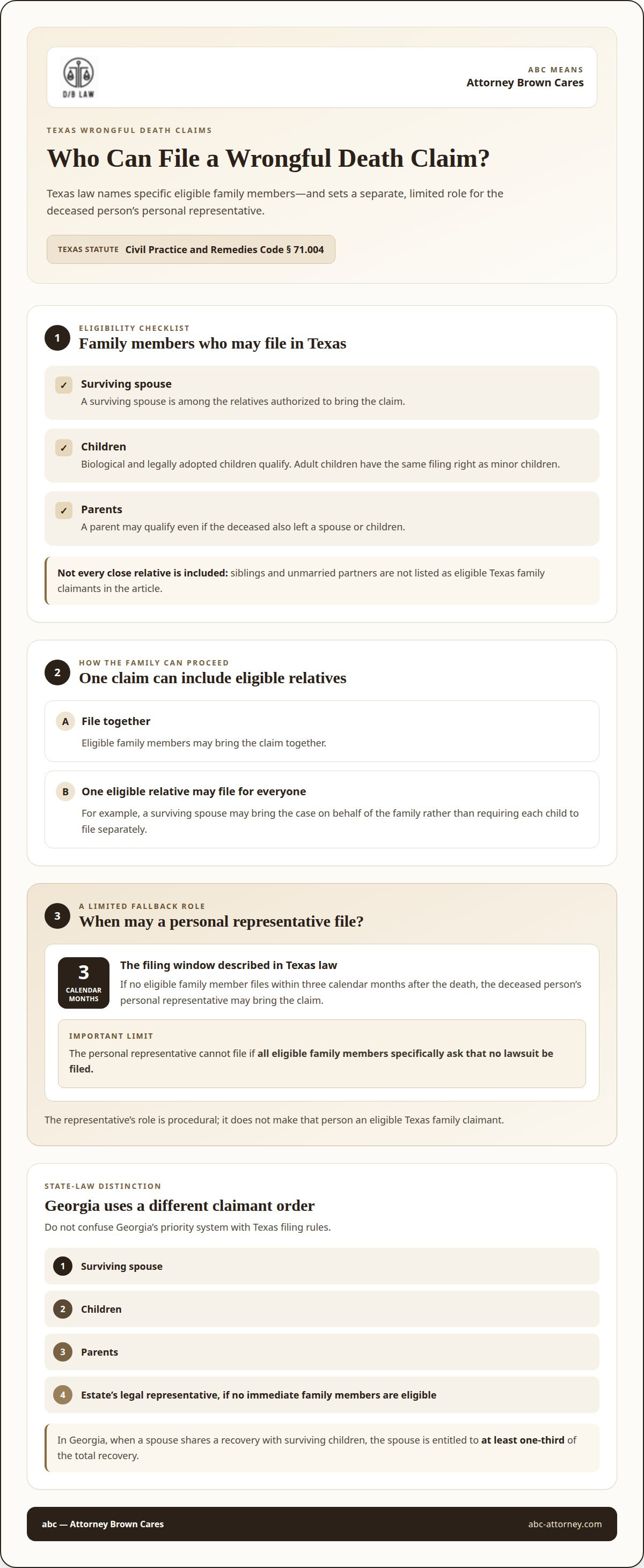
A close family relationship alone doesn’t give everyone the right to sue. In Texas, who can file a wrongful death lawsuit is limited to the deceased person’s surviving spouse, children, or parents under Texas Civil Practice and Remedies Code § 71.004. Biological and legally adopted children qualify, and adult children have the same filing right as minor children.
It’s understandable to be unsure who should act when several relatives are affected. Eligible family members may file together, or one may file on behalf of everyone. If none files within three calendar months after the death, the deceased person’s personal representative may bring the case, unless all eligible family members specifically ask that no lawsuit be filed.
This article explains who may file, how a personal representative can be appointed when needed, and what damages a wrongful death claim may seek. It also explains how eligible relatives can participate in one case, so you can understand the legal process and the issues that may affect your family’s claim.
Table of Contents
Who Has the Right to File a Wrongful Death Lawsuit?
In Texas, the surviving spouse, children, or parents may bring a wrongful death claim. Texas law also allows a personal representative to file in a specific situation.
Georgia’s Claimant Hierarchy
Georgia law sets an order of priority for who may bring a wrongful death action. A surviving spouse has first priority, followed by the deceased person’s children, then parents, and finally the estate’s legal representative if no immediate family members are eligible.
This distinction matters because Georgia’s rules differ from Texas filing rules. In Georgia, a spouse who shares a recovery with surviving children is entitled to at least one-third of the total recovery. The state’s hierarchy identifies who may bring the claim and can affect how a settlement is shared.
Eligible Spouses, Children, and Parents
Under Texas Civil Practice and Remedies Code § 71.004, a surviving spouse, child, or parent may bring a wrongful death claim. The eligible children include biological and legally adopted children, and adult children have the same filing right as minor children.
Texas law allows eligible family members to file together, or any one eligible family member to file on behalf of everyone. For example, a surviving spouse may bring the case for the family rather than requiring each child to file separately. Eligibility depends on the person’s relationship to the deceased, not age alone.
Parents’ Eligibility Without a Spouse or Child
Texas parents are among the relatives authorized to bring a claim under § 71.004. The statute does not limit their eligibility to situations where the deceased left no spouse or child. A parent’s right is therefore distinct from Georgia’s priority system, where parents may bring a claim when the deceased was an unmarried adult without children.
That difference matters for families with several surviving relatives. In Texas, a parent may qualify even when a spouse or child also survives. In Georgia, the spouse and children take priority over parents under the statutory hierarchy.
Personal Representative Filing After Relatives Do Not Act
In Texas, if eligible family members do not file within three calendar months after the death, the deceased person’s personal representative may bring the wrongful death lawsuit. This allows the representative to file when qualifying relatives have not acted within that period.
There is an important limit: the personal representative cannot file if all eligible family members specifically request that no lawsuit be filed. The representative cannot override that collective request. Whether relatives have filed, how much time has passed, and whether the family has made this request all affect who may proceed.
These rules determine who may start the case, but they do not make every relative eligible. A sibling or unmarried partner, for example, is not included in Texas’s list of eligible family members. Identifying the relationship and any filing action helps clarify who may bring the claim and whether the personal representative’s role applies.
Estate administrator’s role when there are no closer surviving relatives
An estate administrator does not automatically replace surviving relatives in a Texas wrongful death claim. Texas law gives filing rights to a surviving spouse, child, or parent. A personal representative may file if eligible relatives have not filed within three calendar months after the death, subject to an important limit: the representative cannot sue if all eligible family members specifically request that no lawsuit be filed.
This differs from states where the estate representative must file the wrongful death action. In those states, a surviving relative may need to ask the probate court to open an estate and appoint a personal representative, particularly if the deceased left no will. The appointment gives someone legal authority to handle the estate’s filing role. It does not, by itself, make that person an eligible Texas family claimant.
For Texas families, the key question is not simply whether closer relatives exist. It is whether an eligible spouse, child, or parent has filed within the statutory period or whether all eligible family members have asked that no lawsuit be filed. For example, a personal representative may step in after three calendar months if no eligible family member has filed and the family has not made that unanimous request. The representative’s role is procedural; the statute gives direct filing rights to specified family members.
Parents remain eligible under Texas Civil Practice and Remedies Code § 71.004, including when the deceased had no surviving spouse or children. The law’s listed categories do not state that parents must wait for an estate administrator to act. Nor does the supplied Texas rule rank a spouse, child, and parent against one another. Georgia has a different statutory hierarchy, with a spouse first, then children, then parents, and then the estate’s legal representative when no immediate family members qualify. That Georgia order should not be treated as Texas law.
A surviving spouse can file with eligible children or parents, and any one eligible family member may file on behalf of everyone. This lets the family proceed through one claimant rather than requiring each eligible relative to bring a separate action. The spouse’s role does not create a separate power to disregard the other family members’ rights. In Texas, the personal representative also cannot proceed if all eligible relatives specifically request that no lawsuit be filed.
Where a death followed a serious accident or a medical event, the family’s filing position depends on these statutory categories and actions, not simply on who handled the deceased person’s affairs. Discuss the filing questions affecting your family when the representative’s role or relatives’ decisions are unclear.
Types of recoverable damages
A Texas wrongful death claim focuses on losses eligible family members suffer after a death. Potential damages may include income the deceased would have earned, expected inheritance, and loss of the relationship. These categories reflect different effects: financial support the family no longer receives and the care, companionship, or connection lost through the death.
A separate estate or survival claim concerns losses the deceased person experienced before death. Depending on the circumstances, it may seek payment for medical care, funeral and burial expenses, and conscious pain and suffering before death. These losses are distinct from relatives’ losses. For example, medical bills for treatment before death concern expenses tied to the deceased, while lost financial support concerns surviving family members.
The distinction can affect how an award is handled. In states requiring an estate representative to file, an award may first be used for medical bills and other expenses before additional funds are distributed to family members. A wrongful death attorney can review which losses belong to the family’s claim and which may relate to the estate. That separation helps clarify which records and circumstances matter.
Eligible family members and the estate do not necessarily receive damages for the same losses. The spouse, children, or parents may be affected by lost earnings, expected inheritance, and the relationship they shared with the deceased. The estate claim, by contrast, addresses losses experienced before death. A child’s loss of a relationship and the deceased’s pre-death medical expenses illustrate why the claims must be evaluated separately.
Distribution also requires attention. After a wrongful death lawsuit ends in a settlement or judgment, the court must approve the distribution of damages. When a settlement occurs before filing, state laws usually require court review and approval of both the settlement and its distribution. This review concerns how the recovery is allocated, not just the total amount agreed upon.
Family members should not assume that one formula applies everywhere. Illinois, for example, allows multiple family members to join one wrongful death lawsuit, with damages divided proportionally according to each person’s degree of dependence on the deceased. That Illinois rule does not establish the distribution method for a Texas claim. Eligible relatives may be able to bring a claim together or have one person act on behalf of others, and a court may review how damages are distributed.
Careful documentation can help distinguish the losses: treatment records and bills relate to care before death, while income and family evidence may support relatives’ claimed losses. The deceased’s medical timeline, household contributions, and family relationships can all matter to the damages analysis.
Who is legally authorized to file a Michigan wrongful death lawsuit
In Michigan, the deceased person’s personal representative may file the wrongful death action under Michigan Compiled Laws § 600.2922. The representative is the person acting for the deceased’s estate in the lawsuit. A surviving spouse, child, parent, or other potential beneficiary may have an interest in compensation, but the representative’s filing role is distinct from who may receive damages. That distinction matters when a family member assumes that being closely related automatically authorizes them to file.
The representative’s role does not mean the representative personally keeps the recovery. Michigan law allows damages to be distributed among eligible survivors and people who would receive the deceased’s property under a will. Potential recipients include a spouse, children, grandchildren, parents, grandparents, siblings, and anyone named to receive property in the will. Family relationships and estate documents help identify who may have a stake in the wrongful death case.
After filing, the personal representative must notify eligible family members within 30 days, according to Michigan law. Notice gives those relatives a chance to understand that a claim is underway and that damages may be distributed among eligible people. For example, a surviving spouse, adult child, parent, or sibling may need to be considered, depending on the deceased’s family and will. The representative’s task is not limited to identifying the person who suffered the most emotionally. The legal recipient categories can extend beyond immediate relatives.
Eligibility to receive damages and authority to file are separate questions. A sibling might belong to a class of potential recipients, yet the personal representative remains the person authorized to bring the action. An executor named in a will may serve as the representative, but the legally important point is the representative’s role in the estate, not the title alone. If there is no surviving family member, Michigan’s intestate-succession law determines who may inherit. That inheritance issue does not change the statutory filing role.
Timing also affects the representative’s work. Michigan Compiled Laws § 600.5805 provides a three-year deadline from the date of death to file a wrongful death lawsuit. The 30-day notice duty begins after the personal representative files; it does not replace the filing deadline. A wrongful death case may involve fatal injury, financial losses, and the deceased person’s suffering before death. Keeping the filing date, death date, and notice to eligible relatives distinct helps clarify each legal step.
The central takeaway is specific: Michigan assigns the filing role to the estate’s personal representative, while potential compensation may benefit a broader group. An executor or representative should identify eligible recipients, provide the required notice, and address distribution under Michigan law. This framework differs from Texas, where the statute identifies eligible family members who may bring the claim directly.
Can multiple eligible family members join a wrongful death lawsuit?
Yes. In Texas, eligible family members may file a wrongful death lawsuit together, or one eligible person may file on behalf of everyone. The eligible group includes the deceased person’s surviving spouse, children, and parents under Texas Civil Practice and Remedies Code § 71.004. Filing together can give the family one coordinated case rather than separate claims brought by each eligible relative.
That option matters when a death affects relatives in different ways. A surviving spouse and an adult child, for example, may both qualify even if they have different financial or personal losses. A parent may also be eligible when a spouse or child survives. The statute identifies who may bring the case; family closeness alone does not make siblings, grandparents, or unmarried partners eligible.
One relative filing on behalf of everyone does not erase other eligible family members’ interests. It provides a way to bring the claim without requiring every spouse, child, and parent to file an individual lawsuit. The filing choice should account for who qualifies and which relatives the case is intended to include. If two eligible relatives disagree about proceeding, their circumstances may raise questions about representation and participation that require careful legal analysis.
Other states handle multiple claimants differently. In Georgia, only one wrongful death lawsuit may be filed for each deceased person. In Illinois, multiple family members may join the same lawsuit, and damages are divided proportionally according to each person’s degree of dependence on the deceased. These examples show why procedures from another state should not be assumed to govern a Texas case.
Separate filings can also create complications. In states that prioritize surviving relatives, there can be only one wrongful death lawsuit; if two or more survivors file separate cases, courts usually consolidate them and direct the combined case to proceed. Consolidation brings the cases together, but it does not automatically establish that everyone named is legally eligible to recover.
For a Texas family, the central distinction is between filing together and filing separately. Eligible relatives may proceed jointly, or one may file on behalf of everyone. A family member outside the statutory categories does not gain filing rights simply by joining a relative’s case. Identify the deceased’s spouse, children, and parents before structuring the claim, especially when family members have different views about participating.
Discuss how eligible relatives can proceed together if your family needs to clarify who should be included in a Texas wrongful death claim.
The Dedric Brown Law Firm
The Dedric Brown Law Firm handles personal injury litigation, including cases involving serious injuries that may raise questions about a family’s legal options after a death. The firm can help assess how the circumstances, family relationships, and Texas filing rules affect the next steps. Its name reflects the firm’s ABC message: Attorney Brown Cares, with personal attention to the people behind each case.
Consider reaching out when a fatal event followed a serious injury, such as a truck wreck, or when you need help understanding how an injury-related claim may proceed. The firm also handles traumatic brain injuries, hypoxic and anoxic brain injury, and birth injuries. Contact The Dedric Brown Law Firm to discuss your situation.
Take the Next Step with a Clear Plan
Understanding who can file a wrongful death lawsuit is one part of protecting a family’s interests after a sudden loss. The next step is to connect the circumstances of the death with available records, the people affected, and the losses the family is facing. A careful legal review can help clarify those details and identify questions that still need answers.
You don’t have to resolve every legal or family concern before asking for guidance. The Dedric Brown Law Firm approaches serious injury matters with personal attention and a commitment to fighting for your rights with integrity and dedication. A conversation can help clarify how the facts of your situation relate to possible legal action.
Contact The Dedric Brown Law Firm to discuss your circumstances and consider a clear path forward. Your family deserves thoughtful support as you take the next step.
Frequently Asked Questions
What are the time limits for wrongful death claims in Georgia?
Georgia’s general wrongful death filing deadline is two years from the date of death, according to the Georgia General Assembly. A pending criminal case related to the death may pause that deadline in certain circumstances. For example, if criminal proceedings are ongoing, the civil deadline may require closer review. Families should promptly identify the date of death and any related criminal case, because those facts can affect how much time remains.
Who Can Pursue a Michigan Wrongful Death Case?
The deceased person’s personal representative is the person authorized to file a Michigan wrongful death action under Michigan Compiled Laws § 600.2922. The representative may be an executor or another estate representative. If you’re a relative, distinguish your potential interest in the damages from the authority to start the case. For instance, a sibling may be considered for a share, while the personal representative files the lawsuit.
How Can a Wrongful Death Lawyer Help Me?
A wrongful death lawyer can help clarify which state’s rules apply, identify the proper claimant, and organize evidence about the death and resulting losses. For example, a case involving a medical event may require review of treatment records, while a fatal vehicle crash may involve accident evidence. A lawyer can also assess potential liability and damages, explain procedural choices, and help family members understand how their interests fit into the case.
What About Other Family Members?
Eligibility to bring a wrongful death claim depends on the deceased person’s legal family relationships. Emotional closeness or financial dependence alone does not make them eligible. For example, a sibling may have been a primary source of support, but that relationship alone does not create Texas filing standing. The deceased’s legal family relationships therefore matter.
What if the deceased was partially at fault for the accident?
In Texas, a wrongful death claim may proceed when the deceased person’s share of responsibility was 50% or less. The percentage of responsibility is therefore important when evidence suggests the deceased contributed to the accident. For example, investigators may examine the deceased person’s actions alongside the conduct of others involved. The family’s eligibility to file and the deceased person’s share of fault are separate questions in evaluating a Texas claim.
Who has legal standing to file a wrongful death lawsuit in the United States?
There is no single nationwide rule: filing authority depends on the state whose law applies. Some states authorize designated survivors to sue, while others require an estate executor or personal representative to file. For example, Texas gives eligible relatives direct filing rights, while Michigan assigns that role to the personal representative. The location and circumstances of the death help determine which state’s law governs the case.
Can a surviving spouse file a wrongful death lawsuit?
Yes, a surviving spouse may file in Texas and is among the relatives eligible under the state’s wrongful death law. In some states, however, a personal representative must bring the action even when a spouse survives. A spouse should distinguish the right to file from the right to receive damages, since those questions may follow different rules. The law governing the case controls the answer.
Can children or parents file a wrongful death lawsuit?
Yes. Texas allows a deceased person’s biological or legally adopted children and biological or adoptive parents to bring a wrongful death claim. Adult children have the same filing right as minor children. For example, an adult child living separately from the deceased remains within the eligible category. A person’s relationship to the deceased, including legal adoption where relevant, helps determine whether the statute permits that person to file.


Comments